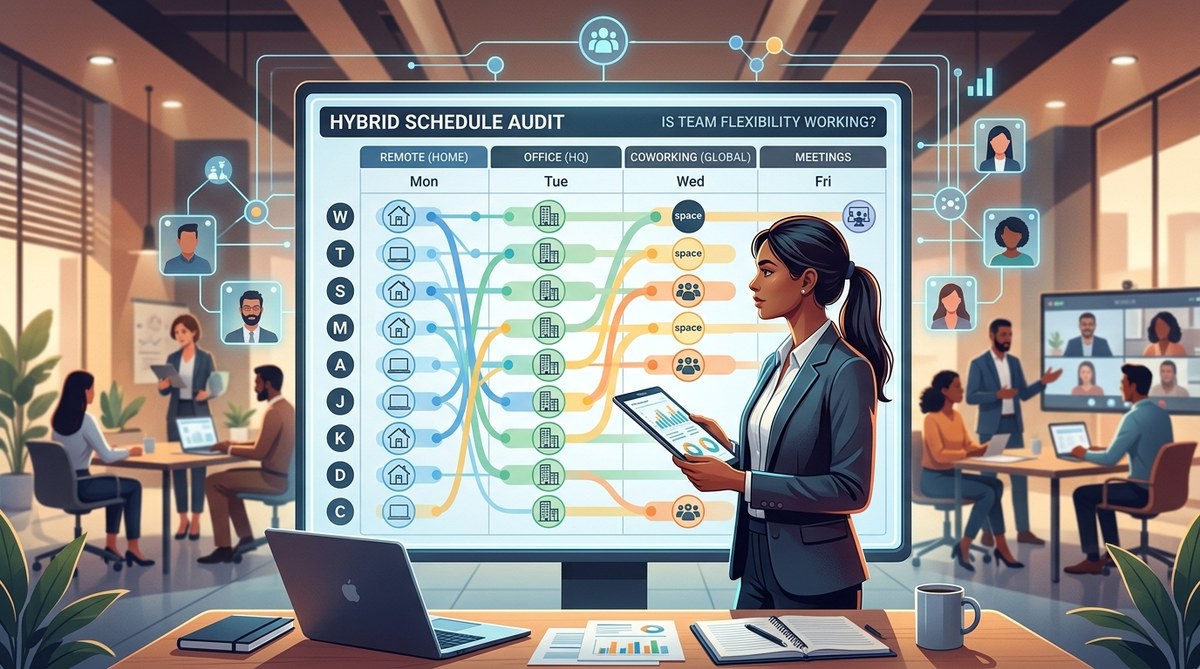
Your team has been hybrid for a while now. Maybe since 2020, maybe longer. You have a policy in place, a calendar system, and a general sense that people like the flexibility. But here is the uncomfortable question: do you actually know if it is working? Not just anecdotally, but with real data on productivity, collaboration, and employee satisfaction. Most managers run on gut feeling when it comes to their hybrid work schedule. And gut feelings can be wrong. That is why you need a hybrid work schedule audit. Not a one-time survey, but a structured review that tells you exactly where your policy is helping and where it is quietly hurting.
A hybrid work schedule audit is a structured review of your team’s flexibility policy. It measures productivity, collaboration, and equity across in-office and remote days. Without one, you risk blind spots that erode trust and efficiency. This guide gives you a repeatable process to run your own audit in 2026.
Why your hybrid policy needs a checkup
Think of your hybrid work schedule like a car. You drive it every day, and it seems fine. But without a regular tune-up, small problems grow. A team member feels left out because they are always remote on the days decisions get made. Another person burns out because they commute three days a week but only see two colleagues in person. These issues compound.
A hybrid work schedule audit catches these problems early. It gives you a clear picture of what is actually happening, not what you assume is happening. And in 2026, with return-to-office mandates making headlines again, you need data to defend your policy choices to leadership.
The three pillars of a hybrid work schedule audit
Before you start collecting data, understand what you are measuring. A good audit covers three areas:
- Productivity: Are projects finishing on time? Are remote days as productive as office days?
- Collaboration: Are teams communicating well? Are some people missing key conversations?
- Equity: Do remote and in-office staff have equal access to opportunities, mentorship, and visibility?
These three pillars form the backbone of your audit. If one is weak, your hybrid model is out of balance.
How to run your hybrid work schedule audit in 5 steps
Here is a repeatable process you can start this week. It takes about two weeks to complete, depending on team size.
-
Gather baseline data. Pull calendar data for the last three months. Count how many days each person worked in the office versus remotely. Note meeting attendance, project deadlines, and any missed handoffs. Use your project management tool for this.
-
Run an anonymous pulse survey. Ask specific questions. Not “do you like hybrid work?” but “do you feel informed about decisions made on days you work from home?” and “do you have the same access to your manager as your in-office peers?” Keep it to 10 questions max.
-
Analyze collaboration patterns. Look at your communication tools. Are remote team members included in key threads? Do in-office groups form spontaneous huddles that exclude remote colleagues? This is where a tool like Slack or Teams analytics can help.
-
Interview team leads and managers. Surveys give you numbers. Conversations give you context. Ask managers what they see day to day. Do they struggle to coordinate meetings across schedules? Do they feel they can evaluate performance fairly?
-
Compare against your policy goals. Go back to your original hybrid policy. What did you want to achieve? Better work-life balance? Higher retention? More focused deep work? Measure your current reality against those goals.
Common audit findings and what they mean
Not every finding is a crisis. Some are easy fixes. Here is a table of common audit results and the actions they suggest.
| Audit Finding | Likely Cause | Recommended Action |
|---|---|---|
| Remote employees miss informal updates | No async communication habit | Adopt a daily written standup or async update channel |
| Office days have low attendance | Mandated days feel arbitrary | Survey team on preferred in-office days and adjust |
| In-office staff get more facetime with leadership | No structured rotation for mentorship | Schedule intentional 1:1s for remote staff |
| Meeting overload on shared days | No coordination of core hours | Set a team agreement on meeting-free blocks |
| Hybrid policy feels unfair to some groups | Different rules for different roles | Standardize core expectations across departments |
The biggest mistake leaders make
They assume their policy is fine because nobody complains. Silence is not the same as satisfaction. Many team members will not speak up about hybrid inequity because they fear losing flexibility. They adapt quietly, and their performance may suffer over time.
“The most dangerous phrase in hybrid management is ‘nobody has said anything.’ People adapt to bad systems silently. You need to look for the friction, not wait for the feedback.” — A senior HR leader with over a decade in distributed team strategy.
That is why a proactive hybrid work schedule audit matters. It surfaces problems before they become retention issues.
What to do with your audit results
Once you have your findings, do not just file them away. Create a short action plan with three priorities. Pick the biggest gap in each pillar (productivity, collaboration, equity) and fix that first. For example:
- If productivity dips on remote days, try setting clearer expectations for async work. Our guide on why your remote meetings feel exhausting can help you reduce unnecessary synchronous time.
- If collaboration is uneven, consider adopting a documentation-first culture. The complete guide to building a documentation-first culture is a great starting point.
- If equity is a concern, look at your meeting patterns. Do remote staff always get the early morning or late evening slots? Keeping remote meetings on schedule when your team spans multiple time zones offers practical solutions.
When to run your next audit
Run a full hybrid work schedule audit every six months. That gives you enough time to see changes from your action plan, but not so long that problems fester. You can also run a lighter check every quarter using just the survey and calendar data.
Making the audit part of your team rhythm
The best audits are not events. They are habits. Build a simple quarterly check-in with your team leads. Ask three questions: Are we hitting our deadlines? Is anyone feeling left out? Do our schedules still match our goals? Keep it short, keep it honest, and keep improving.
Your hybrid work schedule should serve your team, not the other way around. An audit is how you make sure it does.
Your next step
Start your hybrid work schedule audit this week. Pick one pillar (productivity, collaboration, or equity) and gather data on it. You do not need to do everything at once. Small, consistent checks will tell you more than a single massive report ever could. And they will help you build a hybrid model that actually works for everyone, not just the people in the office on Tuesdays.
