
Your team is spread across three continents. Someone in your Slack channel just asked if you’re planning an in-person meetup this year. You pause. Should it be quarterly? Twice a year? Or is annual enough?
Getting the frequency right matters more than you think. Meet too often and you’ll burn through your budget while exhausting your team with constant travel. Meet too rarely and you risk losing the human connection that keeps remote teams thriving.
Most distributed teams benefit from one to four in-person gatherings per year, depending on team size, budget, and collaboration needs. Weekly virtual standups combined with quarterly or biannual in-person meetups strike the best balance for building trust, maintaining momentum, and keeping costs manageable. The key is matching your cadence to your team’s actual collaboration patterns, not industry trends.
What the Research Actually Says About Meeting Frequency
GitLab’s 2023 Remote Work Report surveyed over 3,000 distributed teams. The data showed something surprising.
Teams meeting in person twice a year reported 23% higher satisfaction scores than those meeting quarterly. But teams meeting only once annually showed a 31% drop in cohesion metrics.
The sweet spot? Two to three times per year for most teams.
Buffer takes a different approach. Their fully remote team of 80+ people meets once annually for a week-long retreat. They compensate with strong async communication practices and building a documentation-first culture for distributed teams.
Automattic, the company behind WordPress, gathers teams quarterly but keeps gatherings small. Instead of flying everyone to one location, they organize regional meetups of 5 to 12 people.
The lesson? There’s no universal answer. Your ideal frequency depends on specific factors unique to your team.
Five Factors That Determine Your Meeting Cadence
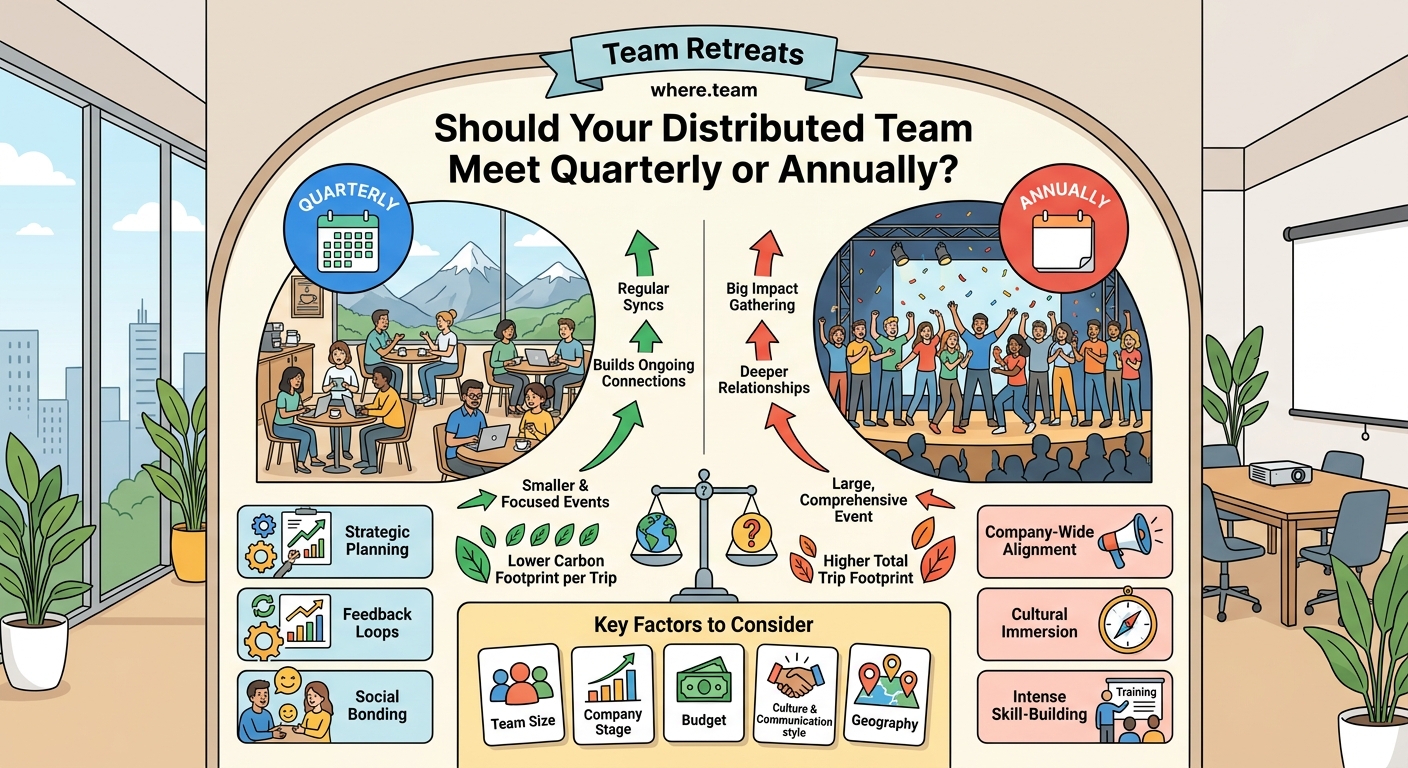
Team Size and Structure
Small teams of 5 to 15 people can realistically meet quarterly without breaking the bank. Larger organizations need a different strategy.
Consider tiered gatherings:
- Company-wide annual retreat (everyone)
- Departmental meetups twice yearly (marketing, engineering, sales separately)
- Team-specific gatherings quarterly (product squads, project teams)
Budget Reality
Let’s talk numbers. A three-day quarterly meetup for a 20-person team costs roughly $40,000 to $60,000 when you factor in flights, accommodation, meals, and venue.
That’s $160,000 to $240,000 annually.
Cut it to biannual and you save $80,000 to $120,000. That budget could fund better tooling, professional development, or hiring another team member.
Planning your first company retreat without breaking the budget requires honest math about what you can sustain long-term.
Nature of Your Work
Some work demands face time. Others don’t.
High collaboration needs (meet more often):
– Product development teams launching new features
– Creative agencies doing brand strategy
– Leadership teams making organizational decisions
– New team formations in first 6 months
Lower collaboration needs (meet less often):
– Customer support teams with clear processes
– Content teams with established workflows
– Mature engineering teams with solid documentation
– Individual contributor-heavy departments
Team Maturity Level
Brand new teams benefit from more frequent touchpoints. A newly formed remote team should consider meeting monthly for the first quarter, then quarterly for the rest of year one.
Established teams with 2+ years of remote collaboration can often thrive with biannual or annual gatherings, especially if they’ve invested in async communication tools that actually work for global teams.
Geographic Distribution
A team spread across two time zones has different needs than one spanning five continents.
When everyone’s within a 3-hour time zone difference, you can lean on synchronous video calls more easily. This reduces the pressure for frequent in-person meetings.
Teams with 8+ hour time zone gaps need either more in-person time or significantly better async practices. There’s no middle ground that works well.
The Four-Tier Meeting Framework
Here’s a practical framework that works for most distributed teams.
| Meeting Type | Frequency | Duration | Purpose | Cost Level |
|---|---|---|---|---|
| Daily/Weekly Virtual | Ongoing | 15-30 min | Alignment, blockers | Low |
| Monthly Virtual Deep Dives | Monthly | 60-90 min | Strategy, planning | Low |
| In-Person Retreats | 1-4x/year | 2-5 days | Bonding, big decisions | High |
| Regional Meetups | 2-6x/year | 1-2 days | Collaboration, workshops | Medium |
Tier 1: Daily or Weekly Virtual Touchpoints
The 15-minute remote standup forms your baseline rhythm. These brief check-ins keep everyone aligned without the overhead of in-person travel.
Keep these focused. No status updates that could be a Slack message. No deep technical discussions better suited for async documentation.
Tier 2: Monthly Virtual Deep Dives
Once a month, carve out 60 to 90 minutes for meatier conversations. Sprint planning, retrospectives, strategy sessions.
These replace the hallway conversations and impromptu whiteboard sessions that happen naturally in offices.
Tier 3: In-Person Retreats
This is where you invest in face time. The frequency depends on those five factors we covered earlier.
Quarterly works well for:
– Teams under 25 people
– High-growth startups in rapid iteration mode
– Organizations with healthy travel budgets
– Groups doing complex collaborative work
Biannual makes sense for:
– Mid-size teams (25 to 100 people)
– Established companies with proven remote processes
– Teams with moderate budgets
– Organizations balancing remote and hybrid models
Annual is sufficient for:
– Large organizations (100+ people)
– Companies with strong async cultures
– Teams with limited travel budgets
– Mature remote-first organizations
Tier 4: Regional Meetups
These fill the gap between full company retreats. Instead of flying your London engineer to San Francisco, let them meet the three other European team members in Amsterdam.
Regional meetups cost 60% to 70% less than all-hands gatherings while still providing valuable face time.
How to Build Your Custom Meeting Schedule
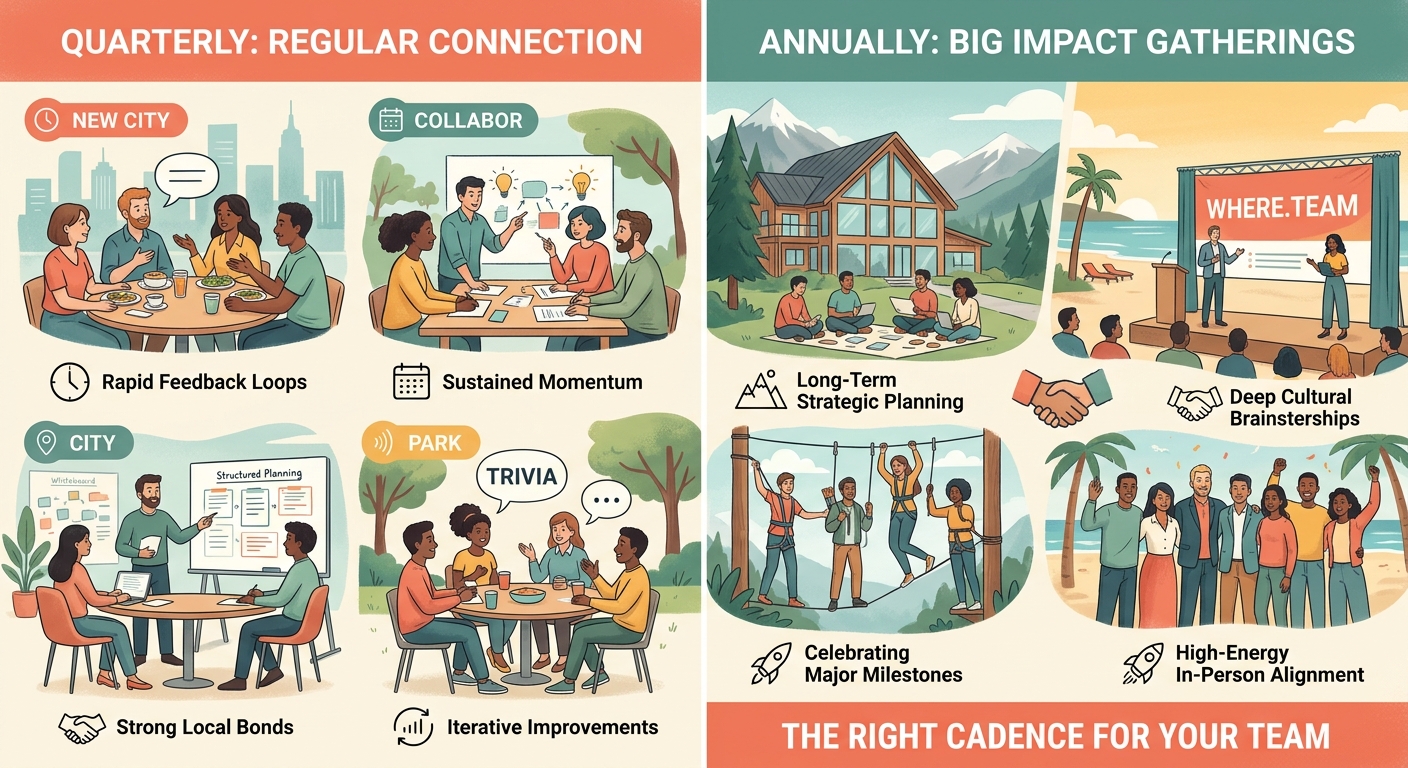
Follow this process to design a cadence that fits your team’s actual needs.
1. Audit your current collaboration patterns
Look at the past three months. When did your team struggle most with alignment? When did async communication break down? Those pain points signal where you need more face time.
2. Calculate your realistic annual budget
Multiply your team size by $2,500 to $3,500 per person per gathering. That’s your baseline cost for a standard 3-day meetup including travel, lodging, and meals.
If that number makes you wince, you need fewer gatherings or smaller regional events.
3. Map your business calendar
Identify natural gathering points:
– Product launch cycles
– Fiscal year planning periods
– Major client deliverables
– Industry conference seasons
Schedule in-person time just before these milestones, not after.
4. Start conservative and adjust
Begin with fewer in-person gatherings than you think you need. It’s easier to add a meetup mid-year than to cancel one you’ve already announced.
Run a retrospective after each gathering. Ask three questions:
– What happened at this meetup that couldn’t happen virtually?
– What could have been accomplished asynchronously?
– Should we meet more or less frequently next year?
5. Communicate the plan clearly
Share your meeting schedule at least six months in advance. Remote workers need time to plan around childcare, partner schedules, and personal commitments.
Update your team handbook with:
– Expected in-person meeting frequency
– Typical duration and format
– Who’s required to attend
– How travel and expenses work
– What happens if someone can’t make it
Common Meeting Frequency Mistakes to Avoid
“We started with quarterly meetups because that’s what other startups were doing. By month nine, we realized we were burning $200K annually on gatherings where half the agenda could have been a Loom video. We switched to biannual and haven’t looked back.” – Sarah Chen, Head of Remote Operations at a 45-person SaaS company
Here are the mistakes that waste budget and exhaust teams:
Copying another company’s cadence without examining your own needs. What works for a 15-person design agency won’t work for a 200-person engineering organization.
Treating in-person time like extended video calls. If you’re doing presentations and status updates, you’ve wasted everyone’s time and money. In-person gatherings should focus on team retreat activities that actually build trust.
Ignoring the hidden costs. Flight and hotel are obvious. But what about the productivity loss from three days out of office? The recovery time from travel fatigue? The costs of hybrid work that don’t show up on expense reports?
Failing to prepare properly. A poorly planned quarterly meetup does more harm than good. Teams return feeling like they wasted time and money. Choosing the perfect coworking space for your remote team’s quarterly meetup matters as much as the frequency.
Not accounting for meeting fatigue. Back-to-back video calls drain energy. So does constant travel. If your team is already experiencing exhausting remote meetings and Zoom fatigue, adding more in-person gatherings might make things worse, not better.
Adjusting Frequency as Your Team Evolves
Your meeting cadence shouldn’t stay static. Here’s when to reconsider:
When you cross 25, 50, or 100 people. Each threshold demands a different approach. What worked at 20 people becomes logistically impossible at 75.
After major organizational changes. Mergers, leadership transitions, or strategic pivots all warrant temporarily increasing face time.
When remote work policies shift. Moving from fully remote to hybrid? From hybrid to fully distributed? Your in-person meeting needs will change accordingly. Consider designing a hybrid work schedule that actually works before committing to a new cadence.
During rapid growth phases. Doubling headcount in six months? Plan an extra gathering to integrate new team members. Once growth stabilizes, return to your normal rhythm.
When async practices improve. As your team gets better at ditching real-time meetings and documenting decisions, you can reduce in-person frequency without losing effectiveness.
Making Virtual Time Between Gatherings Count
The quality of your virtual collaboration directly impacts how often you need face time.
Teams with strong async practices can meet less frequently. Teams that struggle with virtual work need more in-person time to compensate.
Invest in the fundamentals:
- Reliable video conferencing setup with cameras that actually work for remote teams
- Proper home office environments that boost productivity
- Ergonomic setups that prevent fatigue during long virtual sessions
- Quality audio gear like noise-canceling headphones that work
When team members can collaborate effectively from home, you’re not using in-person time to compensate for poor virtual practices.
Sample Meeting Schedules by Team Type
Here’s what different teams actually do:
Early-stage startup (8 people, seed funded):
– Weekly 15-minute standups
– Monthly virtual planning sessions
– Quarterly 3-day retreats
– One annual 5-day strategic offsite
Growth-stage company (45 people, Series B):
– Daily async updates via Slack
– Weekly team syncs (30 minutes)
– Biannual 4-day all-hands retreats
– Quarterly regional meetups (Europe, Americas, Asia)
Established remote-first org (200+ people):
– Async-first communication culture
– Weekly virtual team meetings
– Annual 3-day company retreat
– Biannual department offsites
– Monthly optional coworking days in major cities with day pass options
Hybrid company transitioning to distributed:
– Twice-weekly team standups
– Monthly in-office days for local team members
– Quarterly full-team retreats
– Biannual leadership offsites
Finding Your Team’s Rhythm
There’s no perfect answer to how often distributed teams should meet. The right frequency balances budget constraints, collaboration needs, and team preferences.
Start with biannual in-person gatherings if you’re unsure. That’s enough to build relationships and tackle big decisions, but not so frequent that it drains resources or exhausts your team.
Pay attention to what happens between gatherings. If alignment suffers and people feel disconnected, increase frequency. If gatherings feel redundant or people struggle to justify the time away from work, pull back.
The goal isn’t to maximize face time. It’s to create just enough human connection that your team can thrive in the virtual space where they spend most of their time. Get that balance right, and the specific number of annual meetups matters less than you think.
