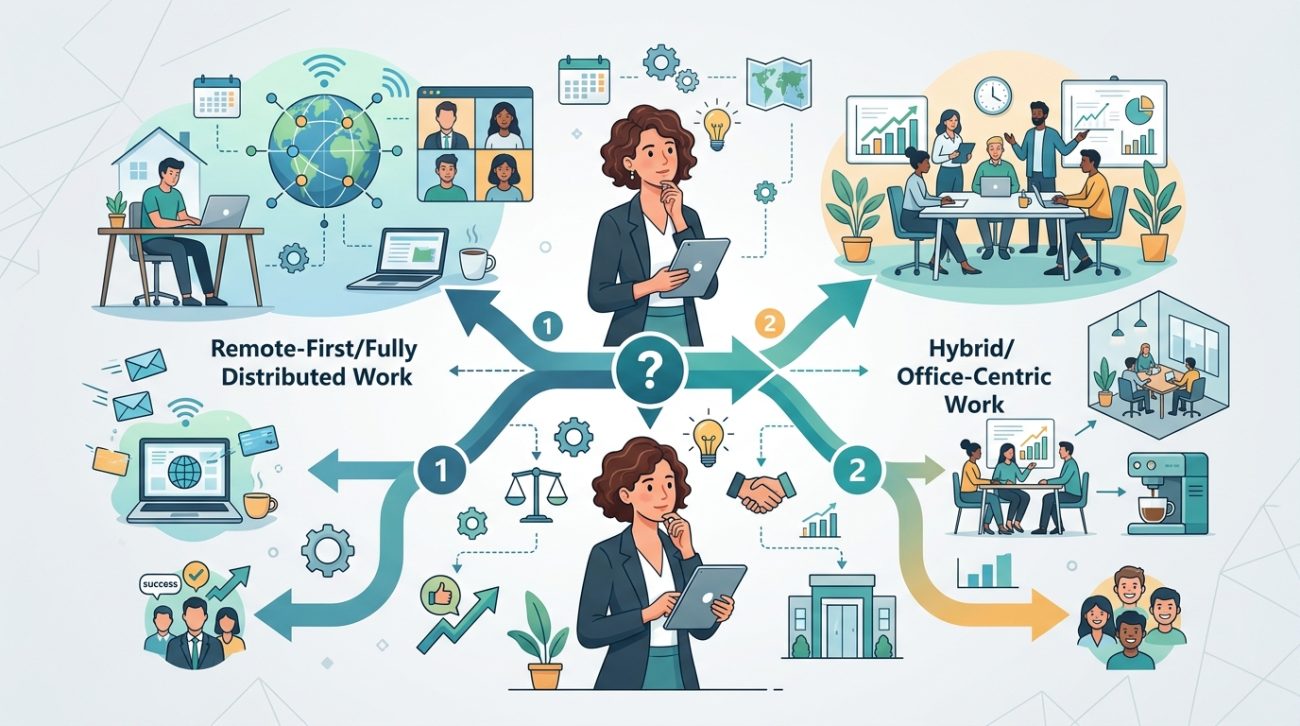
You’re staring at a Slack thread that’s spiraling out of control. Half your team wants to work from home forever. The other half misses the office energy. Your co-founder just forwarded you three conflicting studies about productivity. And you need to make a decision before your next hiring push starts.
Choosing between remote, in-office, or hybrid work isn’t just an HR policy. It’s a fundamental business decision that affects everything from your burn rate to your ability to ship product. Get it wrong, and you’ll watch talented people leave for companies that match their work style preferences.
A hybrid work decision framework for startups requires evaluating five core factors: your product development cycle, team distribution, budget constraints, cultural priorities, and growth trajectory. Most founders skip the framework and copy competitors, leading to policies that create more problems than they solve. This guide walks you through a systematic approach to choosing the work model that actually fits your startup’s reality.
Why most startup work policies fail within six months
You copied Airbnb’s remote-first approach or tried to recreate the Google office vibe. Three months later, your team is frustrated and productivity has dropped.
The problem isn’t the model itself. It’s that you chose based on what sounded good rather than what your specific startup needs right now.
Early-stage companies face different constraints than established tech giants. You don’t have unlimited budgets for office space. You can’t afford to lose a key engineer because they want flexibility. And you’re probably still figuring out your product-market fit, which means your work requirements might change dramatically in six months.
A proper framework accounts for these realities instead of pretending they don’t exist.
The five factors that actually matter for your decision
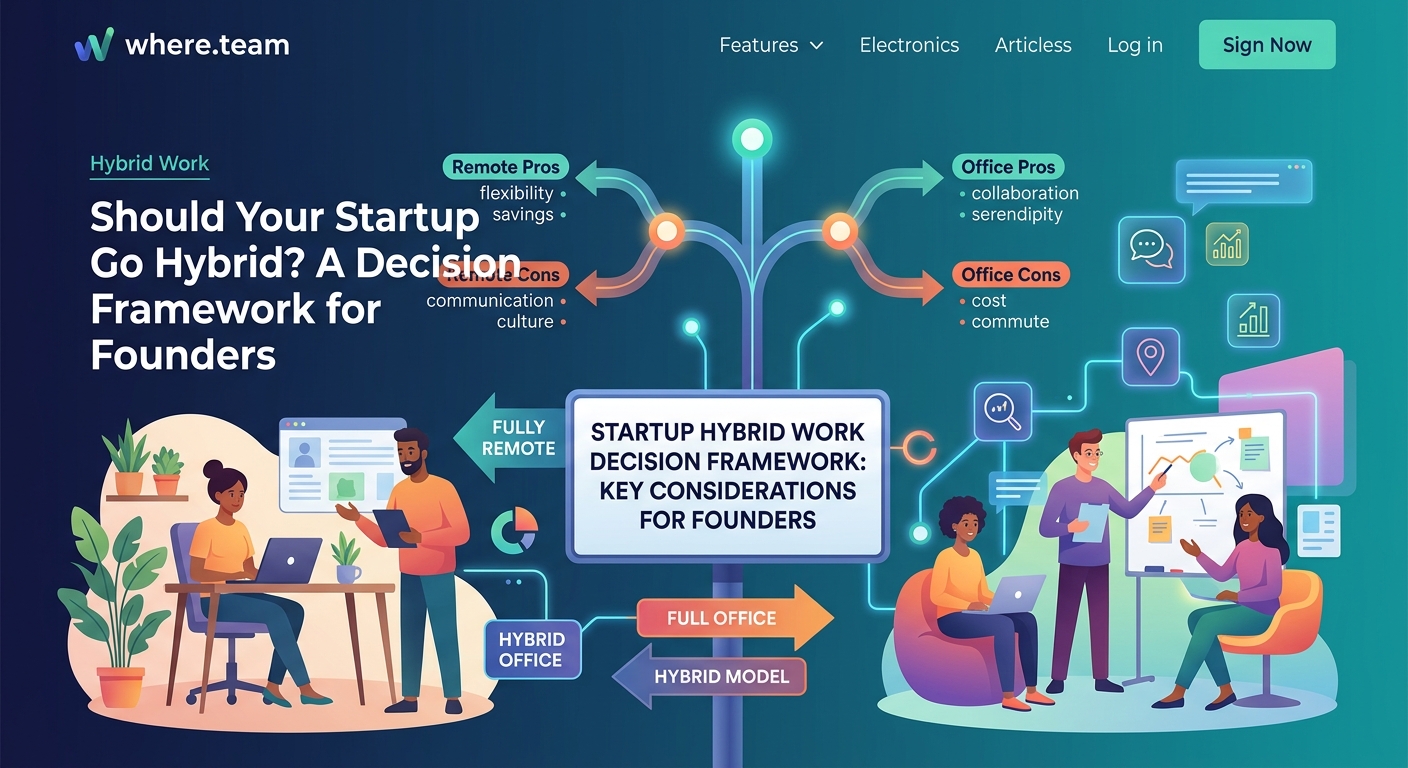
Before you announce any policy, you need honest answers to five questions. Not aspirational answers. Real ones.
Factor 1: What does your product development cycle actually require?
Some work genuinely benefits from real-time collaboration. Some doesn’t.
If you’re building hardware, you probably need people in the same physical space at certain stages. If you’re writing code for a SaaS product, most tasks can happen asynchronously.
Look at your last three sprints. How many times did someone need immediate, in-person help to unblock their work? How often did spontaneous conversations lead to meaningful product improvements versus just feeling productive?
Be brutally honest here. “We like the energy of being together” is a valid cultural preference, but it’s not the same as “our work requires synchronous collaboration.”
Factor 2: Where does your talent actually live?
You might want everyone in your San Francisco office. But if your best backend engineer lives in Austin and refuses to relocate, that preference just became expensive.
Map out your current team and your realistic hiring pipeline. Are you pulling from a local talent pool or competing nationally? Can you actually afford Bay Area salaries for every role?
Many startups discover they’re already hybrid by accident. They hired remotely during the pandemic and now have people scattered across four states. Forcing everyone back to an office means losing half your team.
Factor 3: What can you actually afford?
Office space in major tech hubs costs real money. A decent setup for 10 people in a good location runs $8,000 to $15,000 per month before you add furniture, internet, snacks, and all the other expenses that pile up.
Going fully remote doesn’t mean zero costs either. You’ll need to budget for home office equipment, collaboration tools, and periodic in-person gatherings.
Hybrid is often the most expensive option because you’re paying for both office space and remote infrastructure. Unless you’re strategic about it.
Factor 4: What kind of culture are you actually building?
This is where founders get emotional and stop thinking clearly.
You might love the idea of ping pong tables and catered lunches. But if your team values deep work and flexible schedules more than office perks, you’re solving for the wrong problem.
Talk to your team about what they actually want. Not in a company-wide meeting where people feel pressured to say the “right” thing. One-on-one conversations where they can be honest.
Some teams thrive on constant interaction. Others find it draining and prefer focused async communication. Neither is wrong, but you need to know which describes your actual people.
Factor 5: Where are you headed in 12 months?
Your current team of eight might work great fully remote. But if you’re planning to hire 20 more people in the next year, can you onboard and integrate them effectively without any physical presence?
Similarly, if you’re pre-product-market fit and expect to pivot twice before finding traction, you might need the flexibility to gather everyone for intensive collaboration periods.
Think about your growth trajectory, not just your current state.
A step-by-step framework for making your decision
Now that you understand the factors, here’s how to actually make the call.
Step 1: Audit your current reality
Before you decide anything, document what’s actually happening right now.
- Track how your team currently works for two weeks. How many hours do people spend in synchronous meetings versus async work? When do they say they’re most productive?
- Survey your team anonymously about their preferences and pain points with the current setup.
- Calculate your actual costs for workspace, tools, and remote support.
- Review your hiring pipeline and note where candidates are located.
- List any hard constraints (existing office lease, key employees who won’t relocate, investors who have opinions).
This audit gives you a baseline. You’re not starting from theory. You’re starting from data about your specific situation.
Step 2: Define your non-negotiables
Some things might be absolute requirements for your startup. Write them down.
Maybe you need your security team on-site because of compliance requirements. Maybe your top designer will quit if forced into an office five days a week. Maybe your co-founder is convinced that remote work kills innovation.
Identifying these constraints early prevents you from designing a policy that’s dead on arrival.
Step 3: Model three scenarios
Don’t just pick one option and run with it. Model all three possibilities with real numbers.
| Work Model | Monthly Cost | Hiring Impact | Cultural Fit | Operational Complexity |
|---|---|---|---|---|
| Fully Remote | $3,500 (tools + equipment) | National talent pool | Requires strong async culture | Medium (tools and processes) |
| Fully In-Office | $12,000 (rent + perks) | Limited to local or relocatable candidates | High energy, spontaneous collaboration | Low (everyone in one place) |
| Hybrid (3 days office) | $10,000 (smaller office + tools) | Regional talent pool | Balances both, risks creating two-tier culture | High (scheduling and equity challenges) |
Your numbers will look different. The point is to see the actual tradeoffs instead of guessing.
Step 4: Test before you commit
Whatever you’re leaning toward, run a 30-day experiment first.
If you’re considering hybrid, try a specific schedule for a month. Maybe it’s Tuesdays and Thursdays in the office, rest of the week remote. See what actually happens.
Does collaboration improve on office days? Do people waste time commuting for meetings that could have been async? Does the remote work feel second-class compared to in-office?
Collect feedback weekly. Adjust as needed. This isn’t a binding decision yet.
Step 5: Design the policy with intentionality
Once you know which direction works, create a policy that’s specific and defensible.
Vague policies like “we’re hybrid-friendly” create confusion and resentment. Everyone interprets them differently. You end up with some people in the office every day feeling like they’re doing more than remote colleagues who come in once a month.
Be explicit about expectations, especially if you choose hybrid. When do people need to be in the office? What happens if someone moves to another city? How do you handle scheduling challenges across time zones?
Common mistakes that turn good decisions into bad outcomes
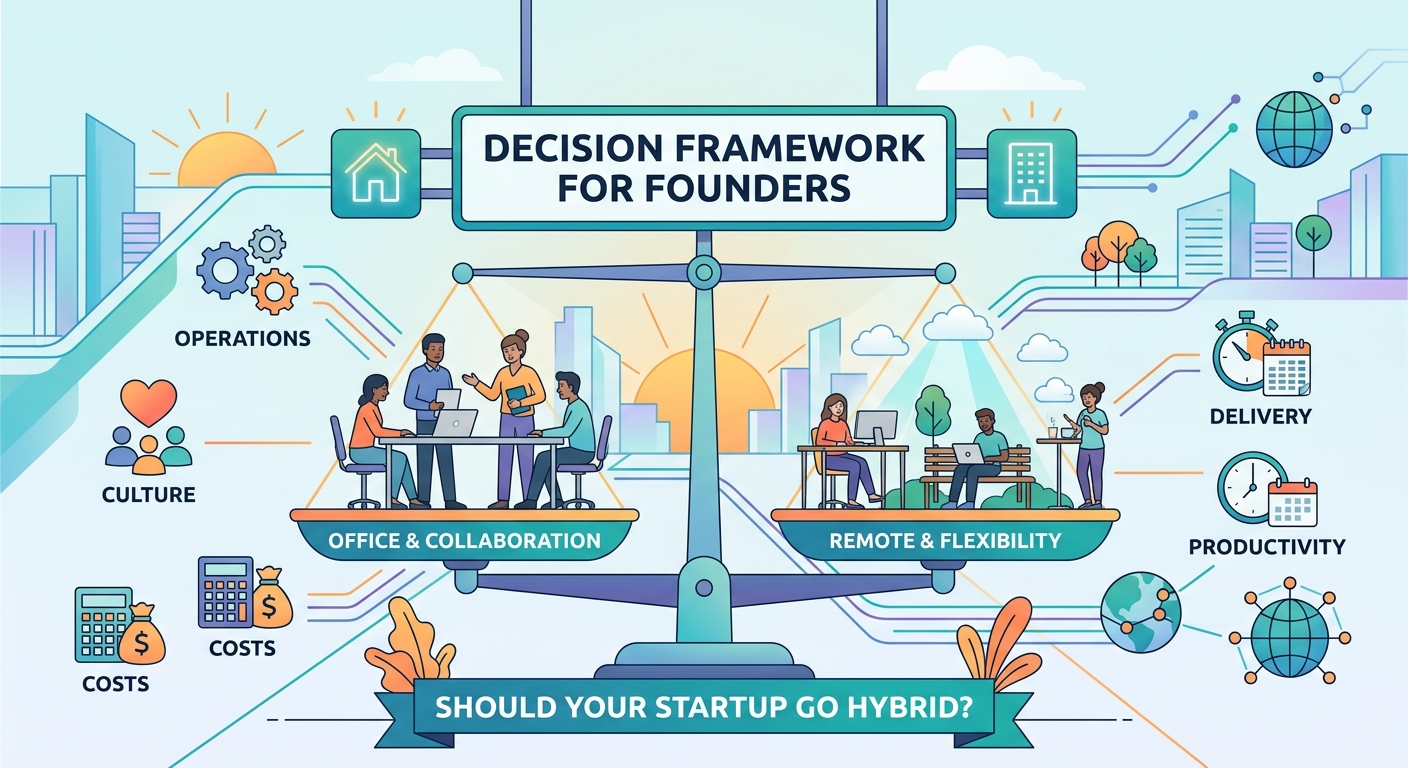
You can pick the right model and still mess up the execution. Here are the traps that catch most founders.
Mistake 1: Treating hybrid as “remote-friendly”
Hybrid doesn’t mean “mostly in-office with occasional remote days.” It means you’ve intentionally designed for both modes to work equally well.
If your hybrid policy creates a situation where remote workers miss important decisions made during office small talk, you’ve built a two-tier culture. People will notice and good people will leave.
The fix is making sure all important communication happens in documented, accessible ways regardless of where people are. Building trust requires intentional systems, not just hoping it works out.
Mistake 2: Copying another company’s approach without adapting it
What works for a 500-person company with established processes won’t work for your 12-person startup that’s still figuring out product-market fit.
Stripe’s remote policy or Basecamp’s async culture might sound appealing. But they built those systems over years with specific teams and challenges. Your context is different.
Use other companies’ experiences as inspiration, not blueprints.
Mistake 3: Ignoring the hidden costs
Fully remote sounds cheap until you realize you need to fly everyone together quarterly for team building. That’s $15,000 to $30,000 per gathering for a small team once you factor in flights, hotels, and venue costs.
Hybrid sounds balanced until you discover you’re paying for coworking day passes for people who live far from your main office, plus maintaining the office itself.
Budget for the actual costs, not just the obvious ones.
Mistake 4: Setting policy without setting up the systems
Announcing “we’re going hybrid” without investing in the tools and processes to make it work is like buying a gym membership and expecting to get fit automatically.
You need video conferencing that doesn’t make everyone exhausted. You need project management tools that work for distributed collaboration. You need clear documentation practices so remote workers aren’t left out of decisions.
The policy is just the announcement. The systems are the actual work.
What to do if your team is split on preferences
This is the scenario that keeps founders up at night. Half your team wants remote. Half wants office. Everyone has strong opinions.
First, separate preferences from requirements. Someone might prefer the office but can work effectively remote. Someone else might need the structure of an office to stay productive. Those are different situations.
For true requirements, you might need to make tough calls. If your head of sales needs to be in-person with the team to function well, and your lead engineer needs remote work to stay, you’re looking at hybrid by necessity.
For preferences, you can often find middle ground. Maybe you have core collaboration days where everyone comes together, and the rest of the week is flexible. Maybe you invest in coworking spaces in multiple cities so people can choose their work environment without being isolated.
The key is making the decision transparent and fair. If you choose a model that disappoints some people, they should at least understand why based on clear business reasoning.
When to revisit your decision
Your work model isn’t permanent. You should plan to revisit it at specific trigger points.
- When you double your team size
- When you raise a significant funding round that changes your budget
- When you open a new office or close an existing one
- When you shift from product development to scaling sales
- When key team members leave specifically because of the work model
Set a calendar reminder to formally review the policy every six months for the first year. After that, annually is usually enough unless something major changes.
“The best work model is the one that matches your actual constraints and enables your team to do their best work. It’s not the one that sounds most impressive to investors or looks best in recruiting materials.” – Advice from a founder who’s tried all three models
Making hybrid actually work if that’s your choice
Hybrid is the most complex option to execute well. If your framework led you here, you need to be deliberate about implementation.
Design a schedule that creates predictability. Random “come in when you feel like it” policies create coordination nightmares. If Tuesdays and Thursdays are office days, everyone knows when to schedule collaborative work.
Invest in making remote participation truly equal. That means good cameras, microphones, and making sure in-office people don’t have side conversations that exclude remote attendees. The right meeting room technology matters more than you think.
Create rituals that work in both modes. Your stand-ups should function well whether people are in the same room or on video. Your brainstorming sessions need structure that includes everyone.
Budget for bringing remote people together periodically. Even the most async-friendly teams benefit from quarterly in-person time to build relationships and tackle big strategic questions.
Practical next steps for implementing your decision
You’ve worked through the framework. You’ve made a decision. Now what?
Write down your policy in clear language. Not HR-speak. Actual sentences that explain what you expect and why. Include specific scenarios so people understand how it applies to their daily work.
Communicate it to your team with the reasoning behind it. People accept decisions better when they understand the tradeoffs you considered. Be honest about what you’re optimizing for and what you’re sacrificing.
Set up the infrastructure before you announce the policy. If you’re going hybrid, have the coworking memberships and collaboration tools ready. If you’re going remote, make sure everyone has proper home office setups.
Plan your first team gathering if you’re remote or hybrid. Even if it’s just a day together, make it count for relationship building rather than just meetings you could have done over video.
Create feedback loops so you can adjust. Monthly check-ins for the first quarter, then quarterly after that. Ask specific questions about what’s working and what’s creating friction.
Your work model should serve your mission, not the other way around
The right answer for your startup depends entirely on your specific circumstances. A deep-tech hardware company will have different needs than a SaaS startup. A team of experienced senior engineers will work differently than a group of recent grads who need more mentorship.
Stop looking for the perfect model that works for every company. It doesn’t exist. Instead, use this framework to find the model that works for your team, your product, your budget, and your goals right now.
The best part about being an early-stage startup is you can still be flexible. You haven’t locked yourself into a 10-year office lease or built an entire culture around a specific work style. You can experiment, learn, and adjust.
Make the decision that sets your team up to do their best work. Everything else is just noise.
