
You’ve secured budget approval, blocked the calendar, and now you’re staring at dozens of venue websites that all promise “inspiring spaces” and “unforgettable experiences.” The photos look great, but how do you actually know which location will work for your team?
Choosing the right venue isn’t about finding the prettiest property. It’s about matching your team’s specific needs with a space that supports your retreat goals, fits your budget, and doesn’t create logistical nightmares.
Selecting a team retreat venue requires balancing location accessibility, capacity needs, activity options, technical capabilities, and total costs. Start by defining your retreat objectives, then evaluate venues against specific criteria like travel time, meeting space quality, accommodation comfort, and contract flexibility. The best venue supports your goals without stretching your budget or creating unnecessary complications for attendees.
Start with your retreat objectives, not the venue
Most people browse venues before they’ve defined what success looks like. That’s backwards.
Before you look at a single property, write down your top three retreat goals. Are you building trust among newly remote teams? Training people on new systems? Celebrating a major milestone? Your objectives shape everything else.
A strategy planning retreat needs excellent meeting rooms with natural light and whiteboards. A team bonding retreat needs outdoor space and activity options. A training intensive needs reliable tech and breakout areas.
Your venue search becomes much simpler when you know what you’re optimizing for.
Location matters more than you think
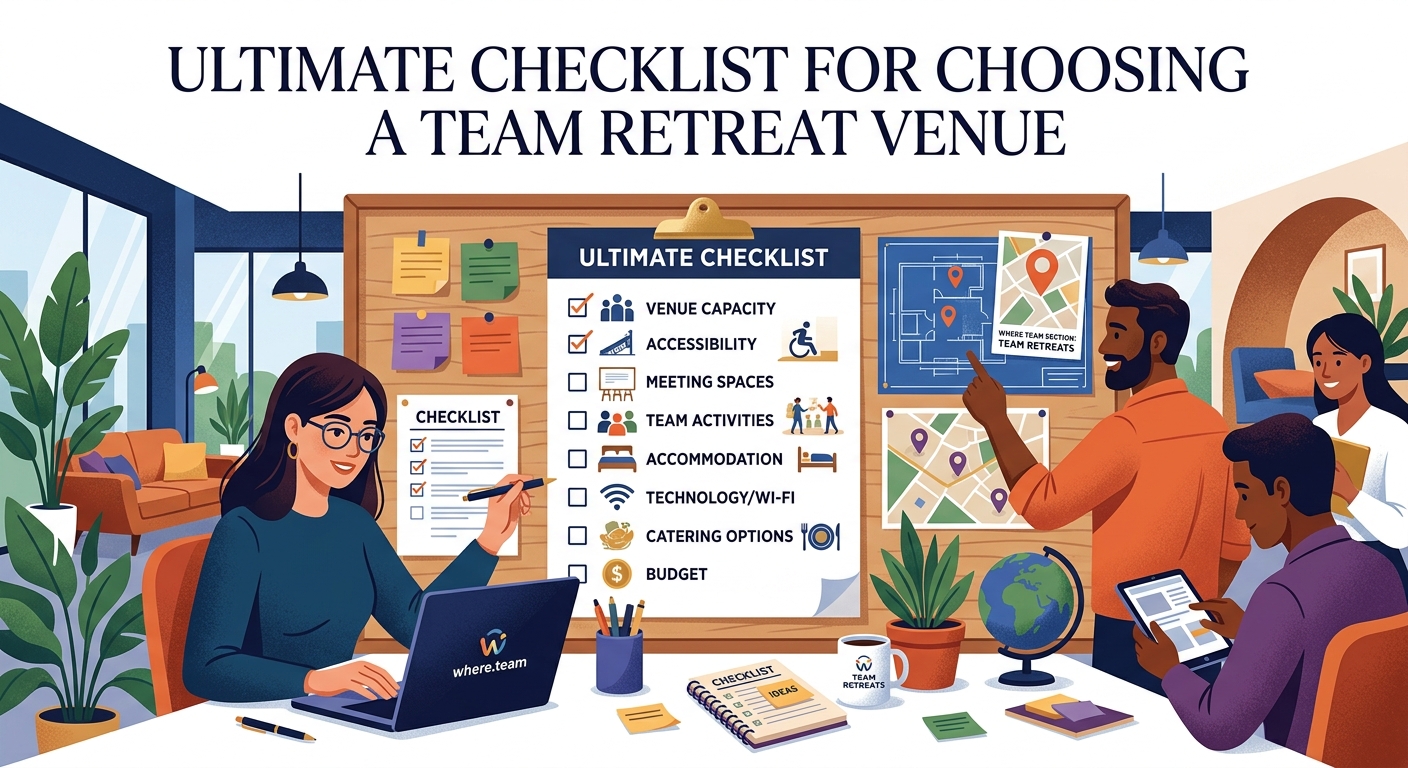
The venue’s location affects attendance, energy levels, and your budget.
Calculate total travel time from your team’s locations. If most people need to take two flights to reach a mountain resort, they’ll arrive exhausted. A venue that’s one direct flight for 80% of your team beats a “perfect” property that requires complicated connections.
Consider time zones too. Bringing together teams from California and New York? A central location helps everyone adjust. International teams might benefit from choosing a location that splits the time zone difference.
Proximity to an airport matters for distributed teams. Look for venues within 45 minutes of a major airport. Anything longer adds stress and increases the chance someone misses their ride.
Think about what happens outside your scheduled activities. Is there a walkable downtown for evening exploration? Are there restaurants within reasonable distance? Teams cooped up in an isolated resort with limited dining options can feel trapped by day three.
Capacity planning goes beyond headcount
You need more than a venue that fits your exact team size.
Plan for 20% more space than your current headcount. Someone might bring a plus-one to the evening event. You might hire two people before the retreat. A vendor might join for a half-day session.
Look at these capacity factors:
- Meeting room size for your largest all-hands session
- Breakout space for small group work (assume groups of 4-6 people)
- Dining capacity for everyone at once
- Sleeping rooms with buffer for roommate preferences
- Common areas where people can work independently
Ask venues about their maximum comfortable capacity, not their absolute maximum. A ballroom that technically fits 100 people might feel cramped and loud at that number.
Evaluate meeting spaces like you’re working there
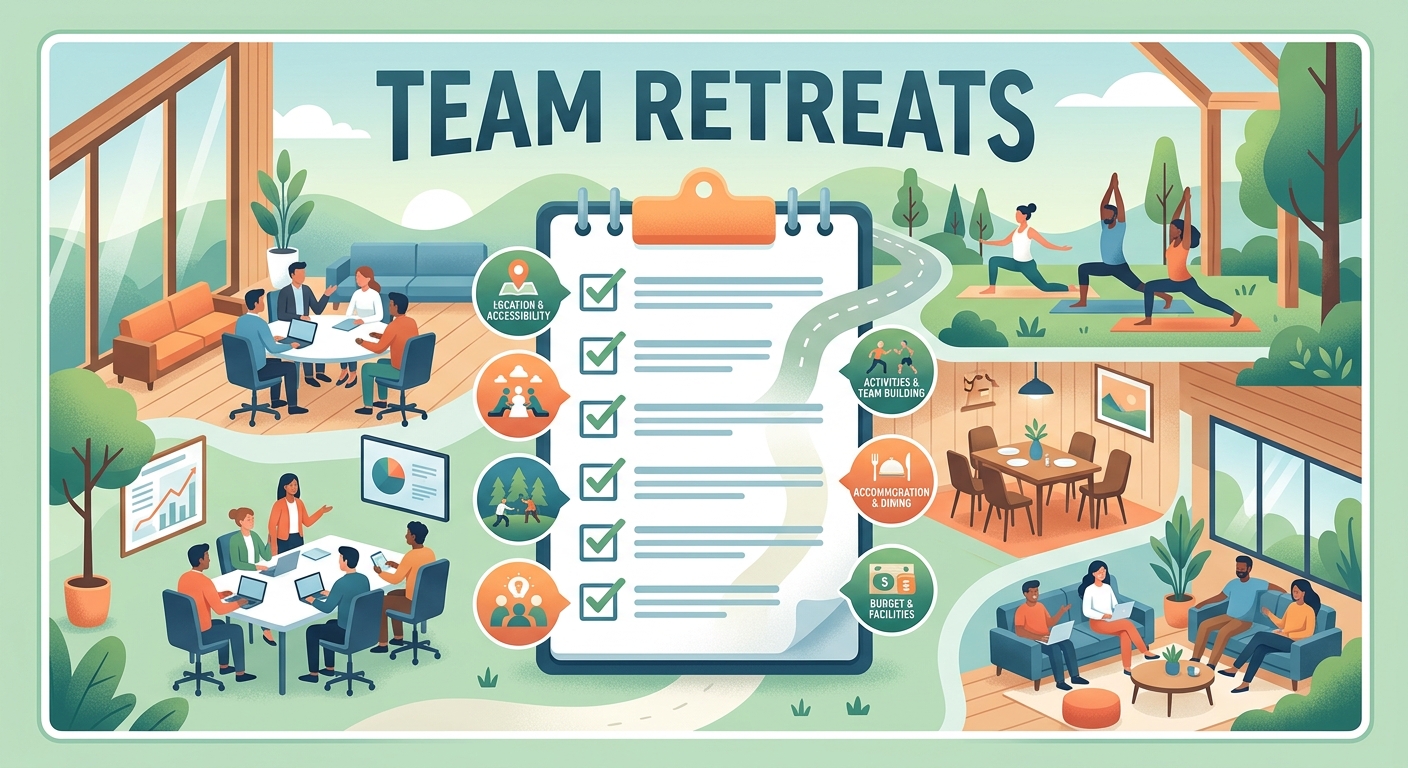
Because you will be.
Walk through the primary meeting room virtually or in person. Can everyone see the screen from every seat? Is there space to move chairs into circles? Are there windows, or will you spend three days in a windowless box?
Test the acoustics. Large rooms with high ceilings can create echo problems. Rooms next to kitchens or busy hallways get noisy during breaks.
Check the furniture situation. Are tables fixed in place? Can you rearrange the room between sessions? Flexibility matters when you’re running different types of activities.
Natural light affects energy and mood. Rooms with windows and adjustable lighting help people stay alert during long sessions. If you’re planning intensive work sessions similar to those exhausting remote meetings, good lighting becomes even more critical.
Technology requirements you can’t skip
Nothing kills retreat momentum like tech failures.
Get specific about internet bandwidth. “High-speed WiFi” means nothing. Ask for actual speeds and how many simultaneous users the network supports. If you’re running hybrid sessions with remote participants, you need upload speeds of at least 25 Mbps.
Verify these technical basics:
- HDMI and USB-C connections for multiple laptop types
- Backup projector or large screen
- Microphone system for rooms over 30 people
- Power outlets accessible from all seating areas
- Cell phone signal strength throughout the property
Request a tech rehearsal time before your first session. Test screen sharing, video calls, and audio levels. Find problems when you have time to fix them.
Some venues charge separately for AV equipment. Get itemized pricing for everything you’ll need. That “affordable” venue might become expensive once you add projector rental, microphone fees, and tech support charges.
Accommodation standards affect retreat success
People can’t engage fully if they didn’t sleep well.
Tour the actual room types your team will use, not just the premium suites. Check mattress quality, noise levels, temperature control, and bathroom conditions. A room that looks fine in photos might have paper-thin walls or a heating system that sounds like a jet engine.
Consider rooming arrangements carefully. Some teams prefer private rooms for everyone. Others save money with double occupancy. Know your team’s preferences before you book.
Look at these accommodation factors:
- Distance between sleeping rooms and meeting spaces
- Quiet hours policies
- Room service or mini-fridge options
- Workspace in rooms for people who need to handle urgent work
- Accessibility features for team members who need them
Food and beverage planning prevents problems
Meal quality and timing affect energy and engagement.
Ask about dietary restriction capabilities before you book. Can they handle vegan, gluten-free, and allergen requests? How much notice do they need? Some venues excel at this. Others offer a sad salad as the only vegetarian option.
Understand what’s included in your package. Does the quoted price cover all meals? Snacks during breaks? Coffee all day? Hidden food costs add up fast.
Timing flexibility matters. If your afternoon session runs long, can dinner shift by 30 minutes? Rigid meal schedules create unnecessary stress.
Look for venues that allow outside catering or have multiple on-site restaurants. Eating the same buffet three times a day gets old. Variety keeps people happy.
Activity and recreation options support bonding
The best retreat moments often happen outside formal sessions.
Evaluate on-site activities that match your team’s interests. Hiking trails work great for active teams. Game rooms and lounges suit groups who prefer low-key socializing. The right activities help people connect naturally, similar to the trust-building approaches in effective team retreat activities.
Consider accessibility. Not everyone can or wants to do high-intensity activities. Offer options that work for different fitness levels and physical abilities.
Weather backup plans matter. That outdoor team building activity needs an indoor alternative when it rains.
Ask about activity timing and costs. Some venues include activities in your package. Others charge per person, which can blow your budget with a large team.
Contract terms and cancellation policies protect you
Read the fine print before you sign anything.
Understand the deposit structure and payment schedule. When is the final headcount due? What happens if three people can’t attend? Can you add people at the last minute?
Cancellation policies vary widely. Some venues offer full refunds with 60 days notice. Others keep your deposit no matter what. Given how unpredictable distributed team schedules can be, especially for teams still figuring out whether to meet quarterly or annually, flexible cancellation terms matter.
Get clear answers on these contract points:
- Damage deposit requirements and refund process
- Noise restrictions and quiet hours
- Outside vendor policies if you want to bring in facilitators
- Insurance requirements
- Force majeure clauses for weather or emergencies
Ask about attrition clauses. If you book for 50 people but only 40 attend, do you still pay for 50? Some contracts lock you into the original number.
Budget for the total cost, not just the venue
The venue price is only part of your retreat budget.
Calculate these additional costs:
- Team travel to and from the venue
- Ground transportation between airport and property
- AV equipment and tech support
- Activity fees and recreation costs
- Team dinner at an off-site restaurant
- Surprise expenses like resort fees or parking charges
Create a spreadsheet with three scenarios: best case, expected case, and worst case. Build in a 15% buffer for unexpected costs.
Compare total cost per person across venues. A more expensive venue with meals and activities included might cost less overall than a cheaper property where you pay separately for everything. These hidden costs are similar to what many teams miss when budgeting for hybrid work.
Site visits reveal what photos hide
If budget allows, visit your top two venue choices in person.
Schedule visits during the day of the week you’d actually host your retreat. A venue that’s peaceful on Tuesday might be overrun with wedding guests on Saturday.
Talk to the staff who’ll support your event. Are they responsive and helpful? Do they understand what you’re trying to accomplish? The venue coordinator can make or break your retreat experience.
Test the basics. Sit in the meeting room. Eat a meal. Walk the path from sleeping rooms to meeting spaces. Small annoyances become big problems when you’re there for three days.
If you can’t visit in person, request a live video tour. Have them show you everything, not just the highlights. Ask to see the least impressive room, not the showcase suite.
Decision-making framework for final selection
You’ve researched venues and narrowed your options. Now you need to choose.
Create a simple scoring system. Rate each venue on your top priorities using a 1-5 scale. Your priorities might include location convenience, meeting space quality, accommodation comfort, activity options, food quality, and total cost.
Weight the scores based on what matters most. If your retreat is primarily working sessions, meeting space quality might count double. If it’s mostly team bonding, activities and common spaces matter more.
| Evaluation Factor | Weight | Venue A Score | Venue B Score | Venue C Score |
|---|---|---|---|---|
| Location accessibility | 2x | 4 | 3 | 5 |
| Meeting space quality | 3x | 5 | 4 | 3 |
| Tech capabilities | 2x | 4 | 5 | 3 |
| Accommodation comfort | 1x | 4 | 4 | 5 |
| Food quality | 1x | 3 | 5 | 4 |
| Activity options | 1x | 5 | 3 | 4 |
| Total cost per person | 2x | 3 | 4 | 5 |
Share your top two choices with a few team members. Get input from people with different needs. Someone with mobility concerns might notice accessibility issues you missed. Remote team members might have different location preferences than office-based staff.
Trust your gut on the final call. If a venue checks all the boxes but something feels off, keep looking.
Common mistakes that derail venue selection
Learn from what others get wrong.
Booking too far in advance without flexibility. Your team might grow or shrink. Your retreat goals might shift. Look for venues with reasonable change policies.
Choosing based on price alone. The cheapest venue often costs more once you add necessary amenities. A mid-range property with everything included usually delivers better value.
Ignoring team member input. The people attending should have a say in where they’ll spend three days. Send a brief survey about location preferences, dietary needs, and accessibility requirements.
Skipping the contract review. Have someone detail-oriented read every clause. Missing a strict cancellation policy or unexpected fee structure creates budget problems later.
Assuming all venues are the same. A beach resort operates differently than a mountain lodge or urban hotel. Each venue type has strengths and limitations.
Making the venue work for distributed teams
Remote-first teams have specific venue needs.
Prioritize locations with strong cell service and backup internet options. Distributed team members often need to jump on calls during retreat downtime.
Look for venues with varied workspace options. Some people need quiet spaces to handle urgent messages between sessions. Others work well in busy common areas. The same flexibility that makes coworking spaces work for quarterly meetups applies to retreat venues.
Consider recording capabilities if you’re running training sessions. People who couldn’t attend might benefit from session recordings, though you’ll want to think through the privacy and compliance implications.
Time zone considerations matter for pre-retreat planning calls and post-retreat follow-up. Choose venues that make it easy for everyone to join virtual planning sessions.
Questions to ask before you book
Get clear answers to these questions:
- What’s your actual WiFi speed, and how many simultaneous users can it support?
- Can we do a walkthrough two weeks before our arrival to finalize room setups?
- What’s included in the quoted price, and what costs extra?
- How do you handle dietary restrictions and food allergies?
- What’s your cancellation policy and refund structure?
- Can we adjust our final headcount, and how close to the event date?
- What happens if we need to extend or shorten our stay?
- Do you have backup plans for outdoor activities if weather doesn’t cooperate?
- What’s your noise policy for evening team activities?
- Can we bring in outside facilitators or vendors?
The best venue isn’t the one with the most amenities or the lowest price. It’s the one that removes friction so your team can focus on the work and connection that matter. Choose a venue that handles logistics smoothly, supports your specific goals, and fits comfortably within your budget.
Your venue sets the stage for everything else
The right venue makes your retreat planning easier and your event more successful.
Start your search early, but don’t rush the decision. Good venues book months in advance, especially during popular retreat seasons. Give yourself at least three months of lead time for major retreats.
Remember that venue selection connects to your broader retreat planning. Once you’ve chosen a location, you can focus on planning activities and managing your budget without worrying about basic logistics.
The venue you choose sends a message about how you value your team’s time together. A thoughtfully selected space shows you’ve considered their needs, comfort, and experience. That attention to detail sets a positive tone before anyone arrives.
Take the time to choose well. Your team will notice, and your retreat will benefit from a venue that truly works for everyone.
