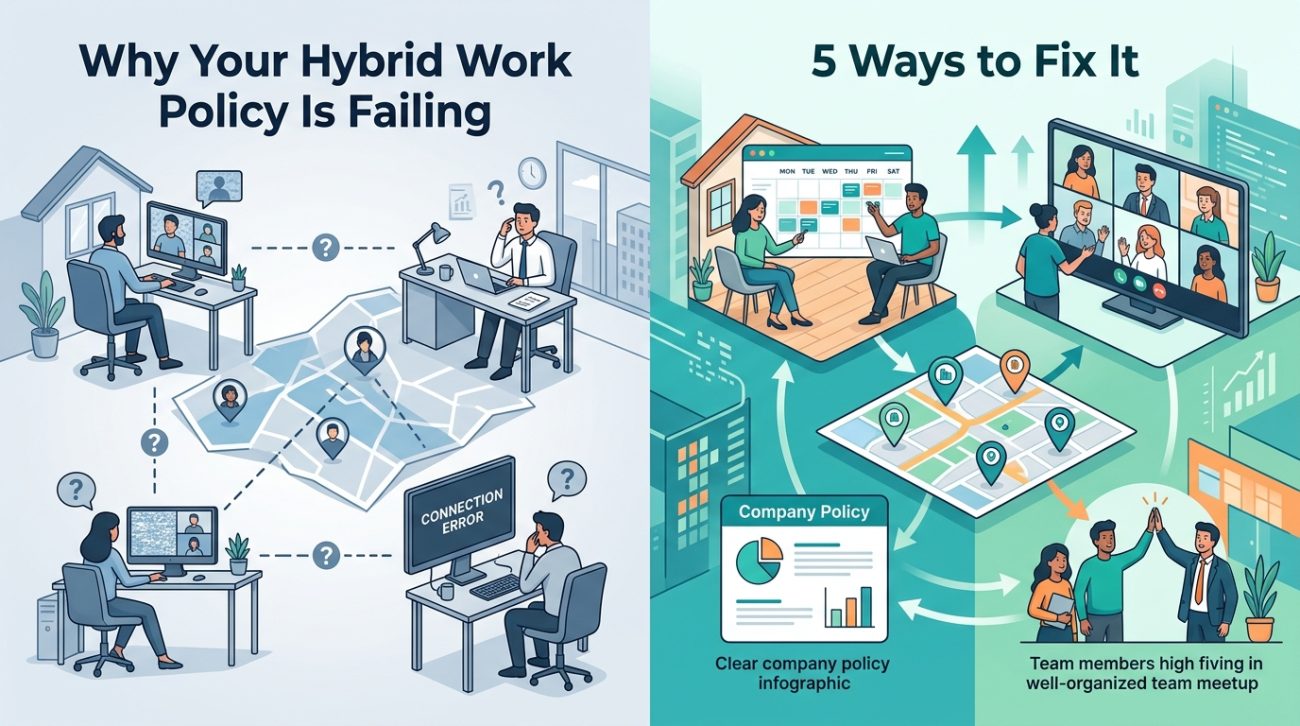
Your team returned to the office two days a week. Morale tanked. Productivity dropped. And now half your staff is updating their LinkedIn profiles.
You’re not alone. Most hybrid work policies collapse within the first year, not because the concept is flawed, but because leaders treat it like a scheduling problem instead of a cultural shift.
Hybrid work fails when companies mandate office days without clear purpose, ignore async communication, skip workspace planning, and treat remote employees as second-class citizens. Success requires intentional meeting design, flexible scheduling, proper technology investment, and a commitment to documentation over real-time presence. The fix isn’t more rules but better systems.
The real reason hybrid policies crumble
Most companies roll out hybrid work like a light switch. Monday and Wednesday in office. Tuesday, Thursday, Friday remote. Done.
Then they wonder why engagement scores nosedive.
The problem isn’t the schedule. It’s that nobody asked why people need to be in the same room. Without a clear purpose for in-person time, your office days become glorified Zoom calls with worse coffee and a commute.
Employees see through this immediately. If they can do the exact same work from their kitchen table, the mandate feels arbitrary. Trust erodes. Resentment builds.
And here’s the kicker: when you force people into the office without intention, you lose both the benefits of remote work AND the advantages of being together.
Five critical mistakes that guarantee failure
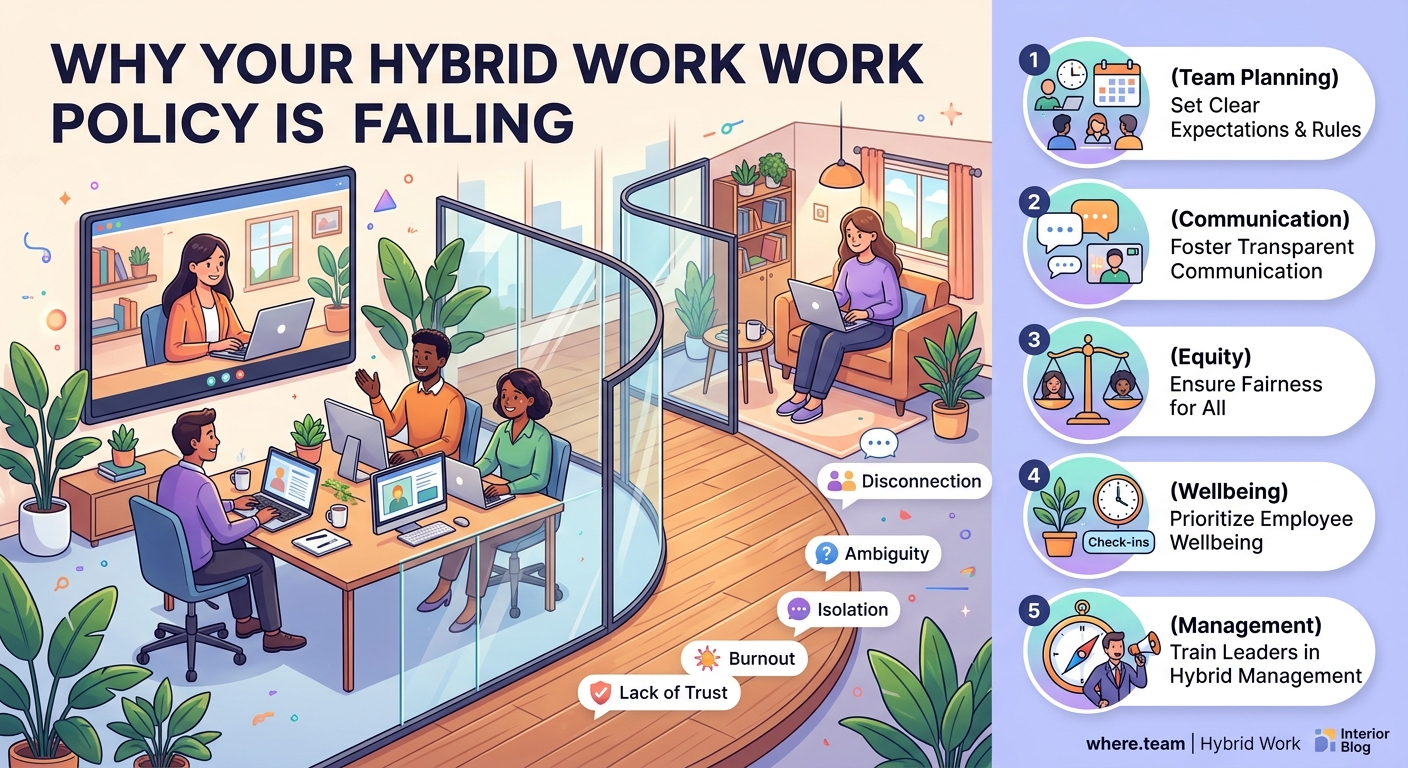
Let’s get specific about what breaks hybrid models.
Mistake 1: Treating office days like regular workdays
You bring everyone in on Tuesday. Then they sit at desks with headphones on, taking the same video calls they’d take at home.
This is expensive theater.
Office days should center on collaboration that genuinely benefits from physical presence. Brainstorming sessions. Design reviews. Difficult conversations. Training new team members. If your Tuesday agenda could happen over Slack, you’ve wasted everyone’s commute.
Mistake 2: Ignoring the remote experience
Here’s a scenario you’ve probably lived: Five people gather in a conference room. Three join via video. The in-room crew has sidebar conversations. Someone references a whiteboard the remote folks can’t see. Audio cuts in and out.
Remote participants become ghosts.
When you design meetings for the room and treat video attendees as an afterthought, you create a two-tier culture. The solution isn’t complicated, but it requires discipline. Why your remote meetings feel exhausting often comes down to this exact dynamic.
Mistake 3: No investment in async communication
Real-time collaboration sounds great until you realize half your team works better at 6 AM and the other half hits their stride at 9 PM.
Hybrid work multiplies scheduling conflicts. Different home locations. School pickups. Medical appointments. Caregiving responsibilities.
Companies that succeed build systems where information flows without requiring everyone online simultaneously. That means documented decisions, recorded meetings, written updates, and clear project tracking.
Building a documentation-first culture isn’t optional anymore. It’s the foundation.
Mistake 4: Mandating schedules instead of outcomes
“Everyone must be in office Tuesdays and Thursdays.”
Sounds fair. Feels equitable. Completely misses the point.
Some roles need synchronous collaboration. Others thrive on deep, uninterrupted focus. Marketing might benefit from Tuesday brainstorms. Engineering might need Thursday afternoons for pair programming. Customer support might work best with staggered coverage.
One-size-fits-all schedules optimize for management comfort, not team performance. Designing a hybrid work schedule means starting with what each team actually needs.
Mistake 5: Underestimating workspace logistics
Your office was designed for 100 people showing up every day. Now 40 people show up on random days.
You need:
– Enough meeting rooms for the teams that coordinate their in-office days
– Desk booking systems so people aren’t hunting for seats
– Proper video conferencing setup in every room
– Reliable internet that can handle simultaneous video calls
– Quiet spaces for focused work
– Collaboration zones for group projects
Many companies also realize their office location no longer makes sense. If your team is distributed across three cities, why maintain expensive headquarters in just one? Choosing the right coworking space for periodic gatherings often beats paying for empty desks.
What successful hybrid companies do differently
Let’s flip this around. Here’s what works.
1. Define clear purposes for in-person time
Successful hybrid companies articulate exactly why they gather physically. Common purposes include:
- Onboarding new employees
- Quarterly planning sessions
- Design sprints requiring rapid iteration
- Team building and relationship development
- Complex problem-solving that benefits from spontaneous collaboration
- Training on new systems or processes
Notice these are events, not routine work. The 15-minute remote stand-up handles daily coordination. Save in-person time for what actually requires it.
2. Build meeting equity into every interaction
Here’s a simple test: If one person joins remotely, everyone joins remotely.
Even if four people sit in the same office, they each log into the video call from their own laptop. This levels the playing field. Everyone has the same view. Same audio quality. Same ability to share screens and participate.
It feels awkward at first. Do it anyway.
You can also rotate meeting leadership to remote team members. Invest in quality equipment. The best video conferencing cameras make a tangible difference in how included people feel.
3. Measure outcomes, not activity
Stop tracking when people work. Start measuring what they produce.
This shift terrifies managers who built careers on visibility management. But it’s the only way hybrid works long-term.
Set clear deliverables. Establish quality standards. Define deadlines. Then trust your team to manage their own time.
You’ll be surprised how much productivity improves when people work during their actual peak hours instead of performing presence during arbitrary office hours.
4. Invest in home office setups
If you expect quality work from home, you need to support quality workspaces at home.
This means stipends for:
– Ergonomic chairs and desks
– Proper lighting
– Reliable internet
– Noise management
– Professional video and audio equipment
Building a home office that actually boosts productivity pays dividends in retention and output. Avoiding ergonomic mistakes prevents expensive health issues down the road.
5. Create intentional connection opportunities
Remote work can feel isolating. Office mandates feel controlling. The answer isn’t forcing people together randomly.
Instead, create valuable reasons to gather:
- Quarterly offsites focused on strategy and team building
- Annual retreats in interesting locations
- Optional coworking days where people can choose to work alongside colleagues
- Virtual coffee chats and social hours
- In-person celebrations for major milestones
Planning company retreats and choosing activities that build trust require thought, but they create genuine connection instead of resentment.
The hybrid work implementation roadmap
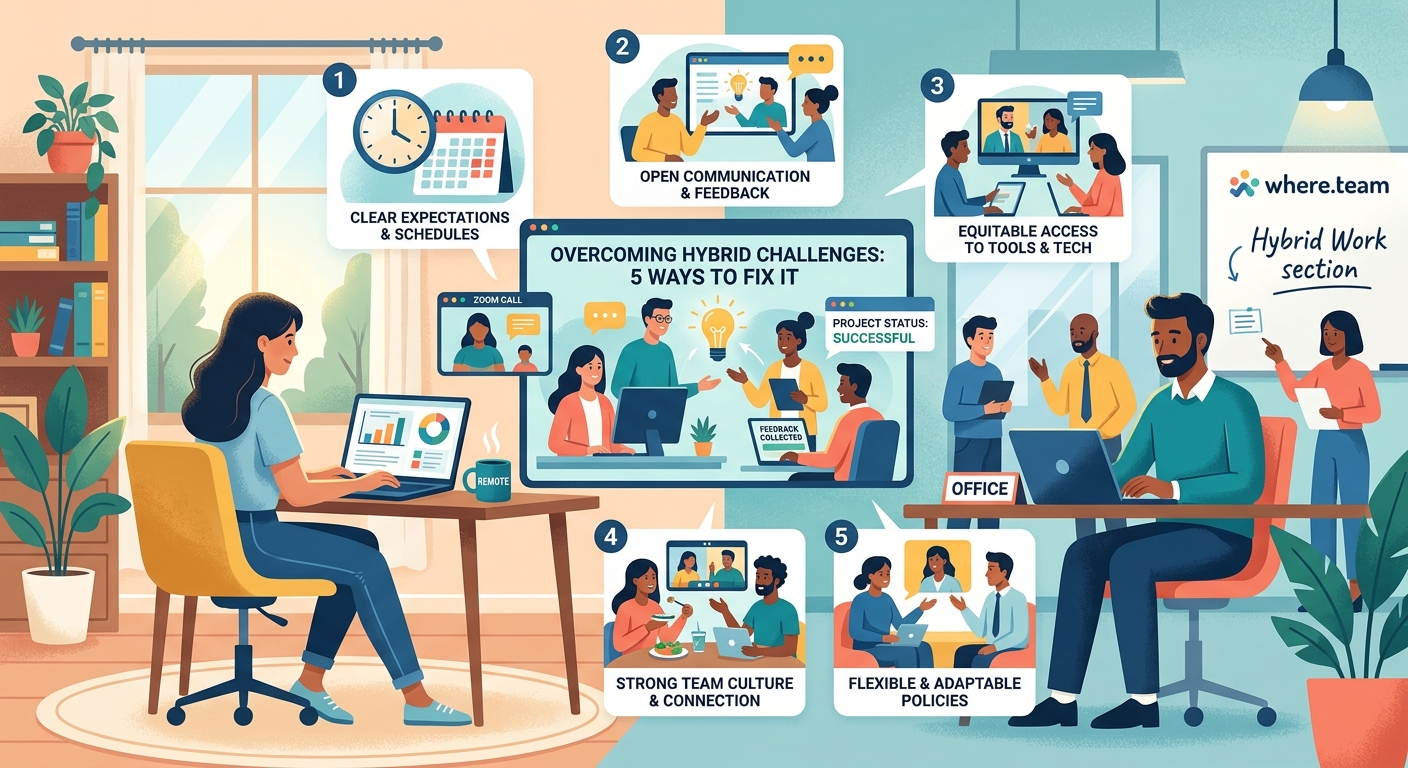
Here’s how to fix a failing hybrid policy step by step.
-
Audit your current state. Survey employees about what’s working and what’s broken. Look at productivity metrics. Check engagement scores. Identify patterns in who’s thriving and who’s struggling.
-
Define your hybrid philosophy. Write down why you’re doing hybrid work. What benefits are you trying to preserve from remote work? What value does in-person time provide? Get leadership aligned on these answers.
-
Redesign your office usage. Map out what activities genuinely benefit from physical presence. Build your in-office schedule around those activities. Everything else can happen remotely.
-
Upgrade your technology. Invest in proper video conferencing. Implement desk booking systems. Upgrade collaboration tools. Choose async communication tools that actually work for your team.
-
Train your managers. Most managers learned to lead by walking around. Hybrid requires new skills. Train them on async communication, outcome-based management, and inclusive meeting facilitation.
-
Pilot with willing teams. Don’t force company-wide change overnight. Find teams eager to experiment. Learn from their experience. Iterate based on feedback.
-
Measure and adjust. Track productivity, engagement, retention, and collaboration quality. Be willing to change what’s not working.
Common hybrid models and their tradeoffs
Different approaches work for different organizations. Here’s a comparison:
| Model | How It Works | Best For | Common Pitfalls |
|---|---|---|---|
| Fixed days | Everyone in office same days | Small teams, collaborative roles | Feels arbitrary, ignores individual needs |
| Anchor days | Core team days plus flexible choice | Medium companies, mixed roles | Can create scheduling chaos |
| Team choice | Each team decides their schedule | Autonomous teams, project-based work | Coordination across teams suffers |
| Fully flexible | Individuals choose when to come in | Mature remote cultures, async-first | Office sits empty, hard to plan space |
| Role-based | Different rules for different roles | Companies with varied work types | Can feel unfair, creates culture divides |
| Event-driven | Gather for specific purposes only | Distributed companies, mature teams | Requires strong async systems |
None of these is inherently right or wrong. The best choice depends on your team size, work type, culture maturity, and geographic distribution.
Understanding the hidden costs helps you make informed tradeoffs.
Technology that makes or breaks hybrid work
Your hybrid policy is only as good as your tools. Here’s what you actually need:
Communication layer:
– Video conferencing that works reliably
– Async messaging with good threading
– Email that doesn’t drown people
– Internal documentation platform
Collaboration layer:
– Shared documents and files
– Project management visibility
– Design collaboration tools
– Code repositories and review systems
Coordination layer:
– Shared calendars
– Desk and room booking
– Time zone management
– Meeting scheduling assistants
Culture layer:
– Recognition and celebration tools
– Virtual watercooler spaces
– Pulse surveys and feedback
– Learning and development platforms
The specific tools matter less than ensuring each layer functions well. Gaps in any layer create friction that compounds over time.
When hybrid isn’t the answer
Let’s be honest. Hybrid doesn’t work for everyone.
Some companies should go fully remote. Others need everyone in office. Hybrid is the hardest model to execute because it requires excellence in both remote and in-person operations.
Consider full remote if:
– Your talent pool is geographically distributed
– Your work is primarily individual and async
– You’re willing to invest heavily in remote culture
– Office costs strain your budget
Consider full office if:
– Your work requires constant real-time collaboration
– You’re in a physical industry (manufacturing, healthcare, retail)
– Your team strongly prefers in-person interaction
– You have space and location that genuinely enhances work
Hybrid makes sense when you need both focused individual work and regular collaborative sessions, when your team has mixed location preferences, and when you can commit to doing both remote and in-person work excellently.
Half-hearted hybrid is worse than choosing either extreme.
Making the shift stick
Changing a failing hybrid policy requires more than new rules. It requires cultural evolution.
Start by acknowledging what’s not working. Your team already knows. Pretending the current system is fine destroys credibility.
Involve employees in the solution. The people doing the work have the best ideas about what they need. Run workshops. Collect feedback. Test ideas.
Commit to iteration. Your first attempt won’t be perfect. Build in regular checkpoints to assess and adjust.
And most importantly, lead by example. If executives demand office presence while working remotely themselves, the policy is dead on arrival.
“The best hybrid policies aren’t about controlling where people work. They’re about creating conditions where people do their best work, wherever that happens to be.”
Building something better
Hybrid work isn’t failing because the concept is broken. It’s failing because most companies approached it as a scheduling problem instead of a fundamental rethink of how work happens.
The companies getting it right started with purpose. They asked what work genuinely benefits from physical presence. They built systems that support both remote and in-office excellence. They measured outcomes instead of activity.
Most importantly, they recognized that hybrid work isn’t about compromise. It’s about combining the best of both worlds. Deep focus time at home. Collaborative energy in person. Flexibility when you need it. Connection when it matters.
Your current policy might be struggling. That doesn’t mean hybrid work can’t work for you. It means your current implementation needs refinement.
Start with one change. Fix your meeting equity. Define clear purposes for office days. Invest in better async tools. Build from there.
The future of work isn’t remote or in-office. It’s intentional. And that starts with fixing what’s broken today.
