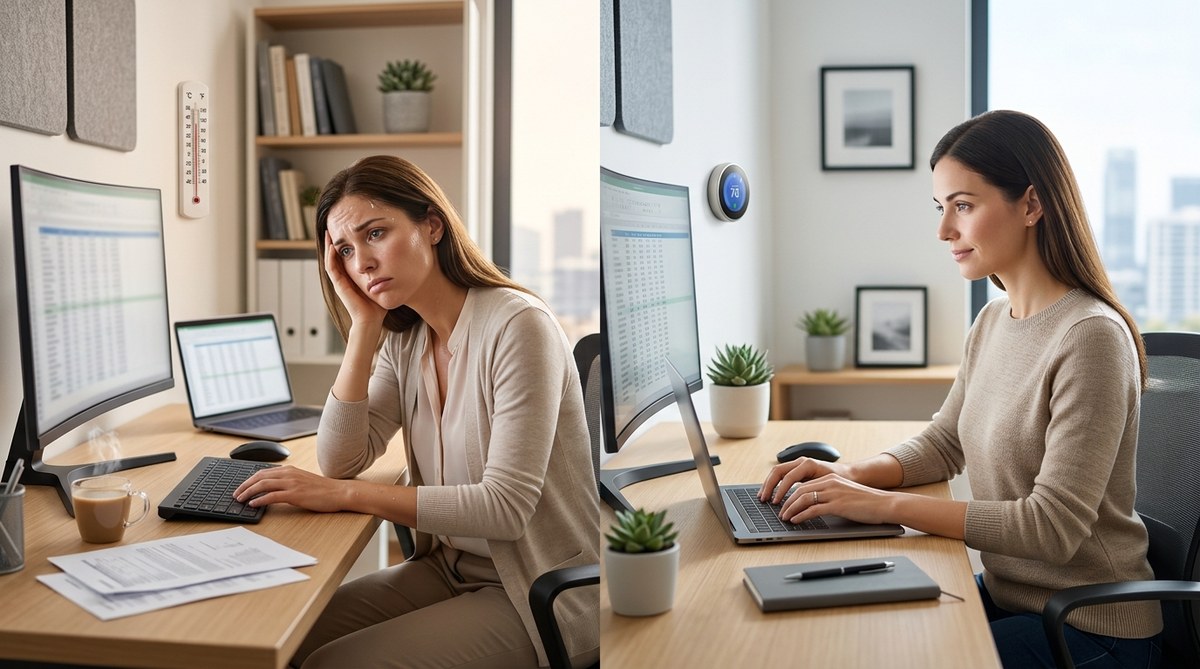
You sit down at your desk, coffee in hand, ready to crush your morning deep work session. But ten minutes in, you can’t stop shivering. Or maybe you’re sweating. Or your nose is cold while your feet are boiling. Your brain starts scanning for distractions, and the spreadsheet in front of you becomes a blur. The culprit is probably hiding in plain sight: your home office temperature.
The optimal home office temperature for focus sits between 68 and 72 degrees Fahrenheit (20 to 22 degrees Celsius). Even small deviations outside this range can lower cognitive performance by up to 10%. Your body diverts energy to regulate temperature instead of thinking. Using a simple thermometer and adjusting your HVAC or adding a fan/heater can restore productivity without major expense.
Why Temperature Wrecks Your Brain
Your brain runs on glucose and oxygen, but it also depends on a stable core body temperature. When your environment pulls you away from that sweet spot, your autonomic nervous system kicks in. Blood vessels constrict or dilate. You start sweating or shivering. These processes eat up energy that should go toward problem solving and creative thinking.
Research from Cornell University found that raising office temperatures from 68 to 77 degrees Fahrenheit reduced typing errors by 44% and boosted output. Other studies show that cognitive performance drops measurably when temperatures stray outside a narrow band. The effect is especially strong for complex tasks like writing code, analyzing data, or planning strategy.
What Science Says About the Ideal Range
Most experts agree on a range: 68 to 72 degrees Fahrenheit (20 to 22 degrees Celsius) for maximum focus. But personal factors matter. Your age, metabolism, clothing, and even gender can shift your personal ideal by a couple of degrees. A 2026 meta-analysis of thermal comfort studies confirmed that women often prefer the warmer end of that range (around 72 degrees), while men tend to feel best closer to 68 degrees.
The key is to find your own “thermal neutral zone” where you are not aware of the temperature at all. That is the spot where your brain can stay on task.
Signs Your Current Temperature Is Hurting Focus
- You find yourself adjusting your clothing or posture constantly.
- You reach for a blanket or take off layers mid-session.
- You feel sleepy or sluggish even after a good night’s sleep.
- You get headaches or dry eyes from forced air.
- You fidget more than usual during calls or focused work.
If any of these ring true, your workspace temperature is likely out of balance.
The Simple 3-Step Fix for a Better Home Office Temperature
Here is a practical process to dial in your optimal home office temperature for focus:
-
Measure accurately. Do not trust the thermostat in the hallway. Buy a cheap digital thermometer and place it on your desk at head level. Your home office microclimate can differ from the rest of the house by 5 degrees or more.
-
Adjust in small increments. Change your thermostat by one degree and wait 15 minutes. Notice any difference in how you feel and how easily you concentrate. Repeat until you hit that neutral zone.
-
Manage local airflow. If the room temperature feels fine but your hands are cold, you might have a draft from a window or vent. Use a small desk fan or a heated mouse pad to target the problem area. A simple [home office lighting setup] that reduces eye strain also helps.
Common Temperature Mistakes That Remote Workers Make
| Mistake | Why It Hurts Focus | Fix |
|---|---|---|
| Cranking the AC in summer | Overcooling forces your body to burn energy staying warm | Set thermostat to 70 degrees and use a ceiling fan on low |
| Blasting heat in winter | Dry, stuffy air leads to fatigue and brain fog | Use a humidifier and set heat to 68 degrees |
| Ignoring the floor temperature | Cold feet pull blood flow away from your brain | Wear warm socks or add a small space heater under your desk |
| Relying on a single thermostat | Different rooms have different microclimates | Place a thermometer on your desk and adjust locally |
| Wearing heavy sweaters indoors | You desensitize yourself to actual temperature | Dress in layers so you can adjust without changing the room temp |
A Word From the Experts
“Temperature is one of the most underrated factors in cognitive performance. When you are thermally comfortable, your working memory, attention span, and decision making all improve. It is not just about comfort; it is about giving your brain the least resistance to do great work.”
— Dr. Lisa Martin, environmental psychologist and author of The Focused Workplace
Dr. Martin has studied thermal effects in offices for over 15 years. Her lab found that a 5-degree shift away from the optimal range can reduce productivity by as much as 10% across an eight-hour workday. That is almost an hour of lost focus every day.
Smart Tools to Help You Maintain the Perfect Temperature
You do not need a full smart home setup. A few inexpensive gadgets can make a huge difference:
- Desk thermometer with humidity sensor (under $20) gives you real-time data.
- Personal space heater with tip-over safety and thermostat (around $30) keeps your feet warm without overheating the whole room.
- USB desk fan (under $15) creates gentle airflow for warmer days.
- Smart plug with a temperature sensor (about $25) can turn a fan or heater on and off based on the actual reading at your desk.
For remote teams, a consistent home office environment also matters during meetings. When you are comfortable, you are less distracted and more present. That is why many distributed companies now include temperature tools in their remote work stipend programs. It is a small investment with big returns.
When the Room Feels Right But Focus Still Sucks
Sometimes temperature is not the only villain. Other environmental factors can stack up:
- Poor air quality (CO2 buildup from a closed room)
- Inconsistent lighting (glare on the screen)
- Noise from appliances or outside
- Uncomfortable chair or desk height
Before you blame the thermostat, check these too. But if you have already dialed in your lighting, ergonomics, and sound, the temperature is almost certainly the missing link. For a complete overhaul of your workspace, read our guide on building a home office that actually boosts productivity.
The Bottom Line on Temperature and Focus
The optimal home office temperature for focus is not a luxury. It is a lever you can pull today to get more done without working harder. Spend 20 minutes this week measuring and adjusting. Your brain will thank you, and your work will reflect it.
Many remote workers overlook this because they think concentration comes purely from willpower. But willpower is finite. Your environment either supports it or drains it. Make temperature your ally, not your enemy.
Ready to take your home office setup further? Check out our comparison of noise-canceling headphones for remote workers and learn why ergonomic keyboards matter in 2026.
