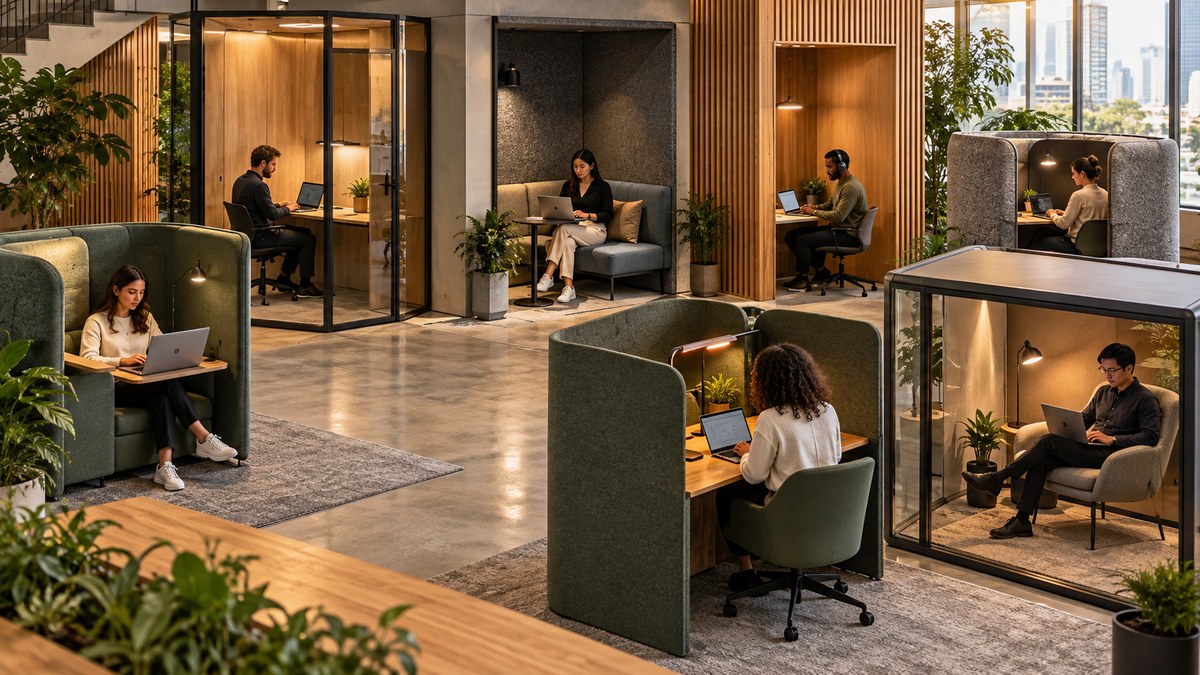
The sound of a coffee grinder, a loud phone call on speaker, and someone having a full team standup at the table next to you. If you have ever tried to write code, draft a strategy document, or do deep analytical work in a standard coworking space, you know the struggle is real. The open floor plan that looks so inspiring on Instagram often turns into a distraction machine. You outgrew your home office because the laundry, the fridge, and the delivery person kept pulling you away. But the typical coworking space can feel like trading one set of interruptions for another. That is why finding coworking spaces with quiet zones is no longer a nice to have. It is essential for any remote team lead or independent professional who needs to produce high quality work without the noise.
Not all coworking spaces are created equal when it comes to silence. The best ones offer dedicated quiet zones with enforced rules, soundproof phone booths, and separate areas for collaboration. This guide covers seven top spaces in 2026 that prioritize deep focus, plus a practical checklist to help you evaluate any space before you commit to a membership or trial day.
Why Quiet Zones Matter More Than Free Snacks
You might think the best perk a coworking space can offer is bottomless kombucha or a fancy espresso machine. Those are nice, but they do not help you finish that quarterly report. For remote teams, the primary reason to leave the house is to find a controlled environment where deep work is possible.
A dedicated quiet zone is not just a corner with a “shh” sign. It is a physically separate area with specific rules. No phone calls. No group conversations. No loud typing on mechanical keyboards (yes, some spaces ban those in the quiet zone). These areas are designed for what Cal Newport calls “deep work” the kind of focused, uninterrupted concentration that produces your best results.
For a remote team lead, quiet zones also solve a coordination problem. When your team is scattered across different locations, you need to know that each member can find a distraction free spot when they need it. This is especially important if you are running a sprint or a focused work session where everyone needs to be in the zone.
The 7 Best Coworking Spaces With Quiet Zones in 2026
We evaluated dozens of spaces across the United States based on three criteria: the strictness of the quiet zone rules, the physical separation from noisy areas, and the availability of private phone booths. Here are the top seven that stood out.
1. The Assembly (Austin, TX)
The Assembly in downtown Austin has a dedicated “Library Floor” that is completely silent. Members are not allowed to take phone calls or have conversations on this floor. There are individual desks with high partitions that block visual distractions. The space also offers soundproof phone booths on the lower floors so you can take calls without leaving the building.
- Quiet zone type: Entire floor, enforced by staff.
- Phone policy: Calls must be taken in designated booths or the lounge area.
- Best for: Solo deep work and small teams that need guaranteed silence.
2. Spacious (Multiple Locations, NYC and San Francisco)
Spacious has rethought the traditional coworking model by partnering with restaurants and hotels that are closed during the day. Their quiet zones are often repurposed dining rooms with high ceilings and minimal foot traffic. The Brooklyn location features a “Focus Room” with noise cancelling panels and a strict no talking policy. The natural light is a bonus for anyone who struggles with eye strain.
- Quiet zone type: Dedicated focus rooms with acoustic treatment.
- Phone policy: Silent mode required; calls go to the lobby.
- Best for: Creative professionals and writers who need a calm atmosphere.
3. WorkHouse (Portland, OR)
WorkHouse in Portland’s Pearl District has a unique approach. They have a “Deep Work Pod” that is a glass enclosed room with white noise machines. You can book it in 90 minute slots. The main floor has an open plan, but the quiet pod is separated by double glazed glass. The space also offers standing desks and ergonomic chairs, which is a plus for anyone dealing with back pain from long hours at a desk.
- Quiet zone type: Bookable glass pods with white noise.
- Phone policy: Pods are phone free; calls must be taken outside.
- Best for: Teams that need a guaranteed quiet space for a specific block of time.
4. The Wing (Washington, D.C.)
The Wing has always focused on community, but their D.C. location includes a “Silent Study” area that rivals any university library. The rules are strict: no laptops on loud settings, no phone calls, and no group work. The space is carpeted to absorb sound, and the desks are arranged in a grid to minimize eye contact and encourage focus.
- Quiet zone type: Library style silent study room.
- Phone policy: Phones must be on silent; calls are not allowed.
- Best for: Deep analytical work like data analysis, writing, or coding.
5. NeueHouse (Los Angeles, CA)
NeueHouse in Hollywood is known for its design, but the Venice location has a hidden gem: the “Writer’s Room.” This is a small, soundproofed room with a single desk and a door that locks. It is available on a first come, first served basis. The main floor has a “Quiet Lounge” with comfortable seating and a strict no talking rule.
- Quiet zone type: Private writer’s room and a quiet lounge.
- Phone policy: Calls are not permitted in either area.
- Best for: Freelancers and solo professionals who need absolute privacy.
6. Industrious (Chicago, IL)
Industrious has a corporate feel, but their Chicago Loop location includes a “Focus Floor” that is separate from the collaborative areas. The floor has a dedicated entrance and its own kitchenette, so you do not have to walk through the noisy common area to get coffee. The desks are spaced far apart, and the lighting is dimmer to reduce visual stimulation.
- Quiet zone type: Entire floor with separate entrance.
- Phone policy: Calls are banned; a phone booth is available on the floor below.
- Best for: Remote teams that need a professional, quiet environment for client work.
7. The Yard (Philadelphia, PA)
The Yard in Philadelphia’s Fishtown neighborhood has a “Sanctuary” room that is designed for meditation and deep focus. It has no windows, soft lighting, and soundproofing. You can book it for up to two hours. The main coworking area is lively, but the Sanctuary offers a complete escape.
- Quiet zone type: Soundproof meditation and focus room.
- Phone policy: No devices allowed; it is a screen free zone.
- Best for: Breaks from screen time and deep thinking without digital distractions.
How to Evaluate a Coworking Space’s Quiet Zone Before You Visit
You should not rely on a website’s description alone. Here is a practical checklist you can use when you tour a space or look at photos online.
| What to Look For | Why It Matters | Red Flag |
|---|---|---|
| Physical separation | A door or a wall between the quiet zone and the noisy area. | The quiet zone is just a corner of the main room. |
| Enforced rules | Staff actively remind people to be quiet or move conversations. | The rules are posted but never enforced. |
| Phone booth availability | At least one phone booth per 20 desks in the quiet zone. | No phone booths nearby, or they are always occupied. |
| Acoustic treatment | Carpet, acoustic panels, or sound absorbing furniture. | Hard floors and bare walls that echo. |
| Lighting control | Dimmable lights or adjustable desk lamps. | Harsh fluorescent lights that cause eye strain. |
| Booking system | You can reserve a spot in the quiet zone in advance. | It is first come, first served with no guarantee. |
Expert advice: “Always visit a coworking space during your typical work hours. A space that looks quiet at 10 AM on a Tuesday might be a different story at 2 PM on a Wednesday. Ask to see the quiet zone during a busy time, and listen for how well the rules are enforced.” – Sarah Chen, Remote Team Operations Consultant
3 Practical Steps to Maximize Your Quiet Zone Experience
Once you have found a space with a strong quiet zone, you need to use it effectively. Here is a simple process.
-
Book your spot in advance. Many spaces allow you to reserve a desk in the quiet zone through their app. Do this the night before, especially if you have a deadline. Treat it like a meeting you cannot miss.
-
Set a focus block with a clear goal. Do not just sit down and hope for the best. Decide what you will accomplish in the next two hours. Write it on a sticky note and put it on your monitor. This prevents your mind from wandering when the silence sets in.
-
Use the phone booth for calls. If you need to take a call, leave the quiet zone immediately. Do not try to whisper. It is disruptive to others and breaks the focus of the entire room. Most spaces have phone booths nearby. Use them.
Common Mistakes Remote Teams Make With Quiet Zones
Even with the best space, teams can undermine their own productivity. Avoid these common errors.
- Booking a quiet zone for a group meeting. Quiet zones are for individual work. If your team needs to collaborate, use a meeting room or a collaborative area. Trying to have a whispered standup in a quiet zone annoys everyone and defeats the purpose.
- Ignoring the rules because “it is just a quick question.” A quick question can break someone’s flow for 20 minutes. Use async communication tools like Slack or async video messages instead.
- Staying in the quiet zone when you are stuck. If you are staring at a blank screen, get up and walk around. Go to the lounge, grab a coffee, or sit in a different area for 15 minutes. Forcing yourself to stay in silence when you are frustrated can lead to burnout.
- Forgetting to test the internet for video calls. Even though you are in a quiet zone, you might need to jump on a call later. Evaluate the internet reliability before you commit to a membership. A fast connection in the main area might be slower in the quiet zone.
How to Negotiate for Quiet Zone Access
If you are a remote team lead looking to book multiple memberships, you have leverage. Many coworking spaces are willing to offer group rates or reserved spots in the quiet zone if you ask.
- Ask for a trial day first. Most spaces offer a free trial day. Use it to test the quiet zone during your peak work hours.
- Negotiate for guaranteed desk access. If you are buying five or more memberships, ask for a guarantee that your team will always have at least one desk in the quiet zone.
- Request a dedicated team area near the quiet zone. Some spaces will let you reserve a cluster of desks near the quiet zone entrance, giving your team easy access without disrupting others.
For more tips on negotiating, check out our guide on how to negotiate group rates at coworking spaces.
When a Quiet Zone Is Not Enough
Sometimes, even the best quiet zone is not enough. If you are working on a project that requires absolute silence, or if you have a team member who is easily distracted, you might need a private office. Many coworking spaces offer private offices that are soundproof and lockable. These are more expensive, but they guarantee zero interruptions.
Another option is to book a meeting room with advanced technology for the day and use it as a personal focus room. This is a good workaround if the quiet zone is full.
Building a Routine Around Quiet Zones
The real power of a quiet zone is not just the physical space. It is the habit you build around it. When you walk into a quiet zone, your brain should know it is time to focus. Here are a few ways to build that routine.
- Use the same desk every time. If possible, request the same desk in the quiet zone. Your brain will associate that spot with deep work.
- Wear noise canceling headphones even if it is silent. The act of putting them on signals to your brain that it is time to work.
- Set a timer for 90 minutes. The Pomodoro technique works well, but for deep work, longer blocks are better. Try 90 minutes of focused work followed by a 20 minute break outside the quiet zone.
Finding the Right Fit for Your Team
Every remote team is different. A team of software engineers might need a quiet zone with standing desks and multiple monitors. A team of writers might prefer a library style setting with natural light. The key is to match the space to the work your team does most often.
If your team travels frequently, look for a coworking network that has quiet zones in multiple cities. This allows your team to have a consistent experience no matter where they are. For example, Industrious has locations in over 20 cities with similar quiet zone setups.
Your Next Step Toward Distraction Free Work
The search for coworking spaces with quiet zones is really a search for control over your attention. You have outgrown the home office because it is too distracting. You have tried the local coffee shop and it is too loud. A dedicated quiet zone in a well designed coworking space is the Goldilocks solution.
Start with the list above. Pick one space near you and book a trial day. Go during your most productive hours. Test the quiet zone. See if the rules are enforced. Notice how much more you get done in two hours of uninterrupted work compared to a full day of constant interruptions.
Your team deserves a workspace that supports deep focus. Your projects deserve your full attention. And you deserve a work environment that does not fight against you. Take the first step today. Find a quiet zone and reclaim your productivity.
