
Planning your first company retreat feels like a high-stakes balancing act. You want to bring your team together, build real connections, and create memorable experiences. But then you look at the budget spreadsheet and reality hits hard. The good news? You don’t need unlimited funds to pull off a meaningful retreat that your team will actually remember.
Planning a company retreat on a budget requires strategic choices about location, timing, and activities. Focus on nearby destinations, off-peak dates, and free team building exercises. Negotiate group rates, share accommodations wisely, and let team members contribute ideas. With smart planning, you can create meaningful experiences that strengthen your team without emptying your bank account or compromising on the core goal of bringing people together.
Start with your actual goals, not your dream itinerary
Before you price out mountain lodges or beach resorts, sit down and write out what you actually need to accomplish. Are you trying to rebuild connections after months of remote work? Do you need focused time for strategic planning? Are you celebrating a milestone?
Your goals shape everything else. A retreat focused on team bonding needs different elements than one centered on product planning. And here’s the thing: expensive venues and fancy activities rarely correlate with meaningful outcomes.
Write down three specific objectives. Make them measurable. “Improve team morale” is too vague. “Give team members unstructured time to connect with colleagues they don’t work with daily” is concrete. You can plan around that.
Pick your location based on math, not aesthetics
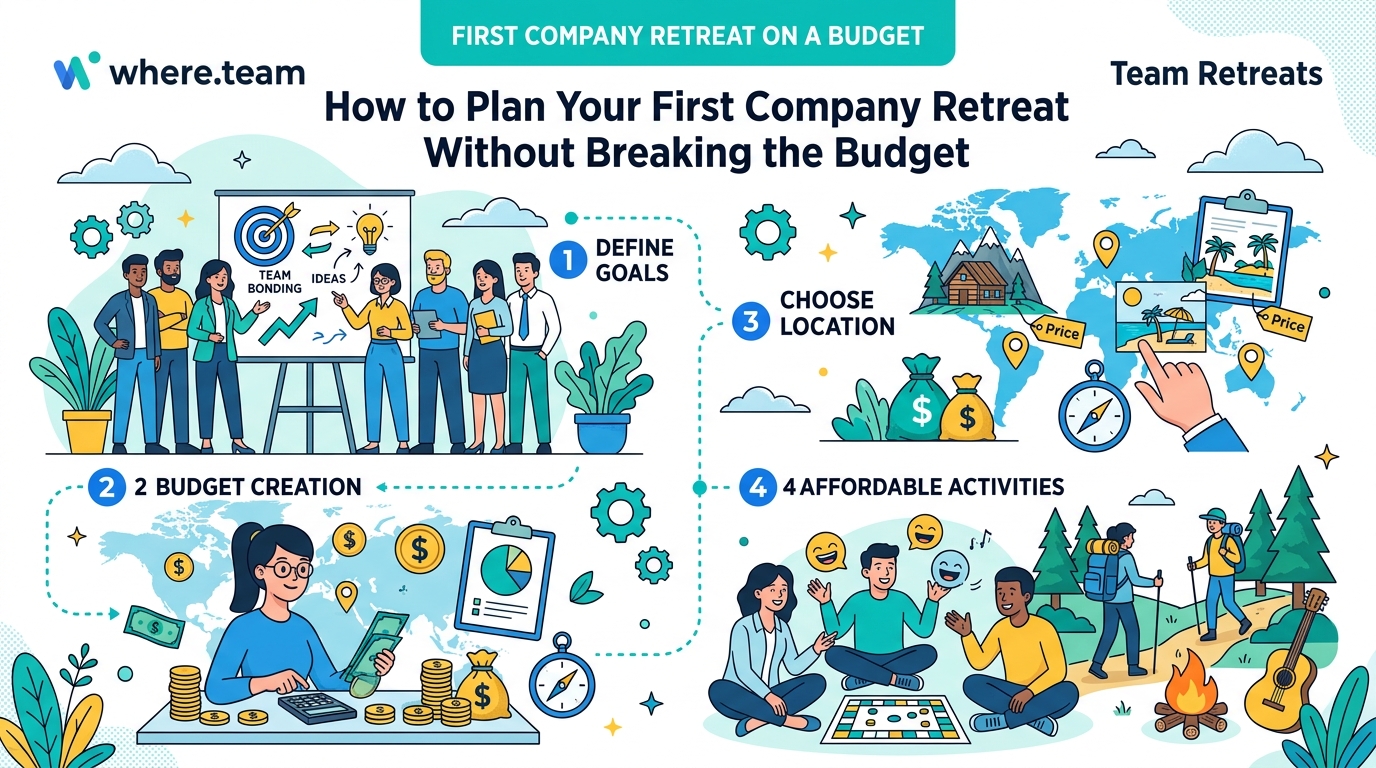
The biggest line item in your retreat budget will be travel and accommodation. This is where most first-time planners blow their budget before they even start.
Here’s a framework that works:
- Calculate where most of your team lives. If 80% of your people are within two hours of Chicago, don’t plan a retreat in San Diego.
- Look for venues within driving distance of your team’s center of gravity. Eliminating flights saves thousands.
- Consider shoulder season dates. A venue that costs $200 per night in July might be $90 in October.
- Search for spaces with kitchens. Cooking even half your meals cuts food costs dramatically.
State parks, university conference centers, and large vacation rentals often cost a fraction of hotels. A house that sleeps 12 people for $400 per night ($33 per person) beats hotel rooms at $120 each.
Yes, someone will need to coordinate more logistics. But that’s your time, not your money.
Master the art of the group rate negotiation
Everything is negotiable when you’re booking for a group. Everything.
Call venues directly instead of booking online. Explain you’re planning a company retreat and ask about group discounts. Many places offer 10 to 20% off for groups of 10 or more, but they won’t advertise it.
Ask about midweek rates. Tuesday through Thursday bookings often come with significant discounts because venues struggle to fill those days.
Request package deals. Can they throw in a meeting room? What about early check-in or late checkout? Breakfast? WiFi upgrades? The worst they can say is no.
One founder I know saved $1,200 on a retreat by simply asking if the venue had any upcoming slow weeks they needed to fill. They did, and they cut the rate by 30% to secure the booking.
Design activities that cost nothing but create everything
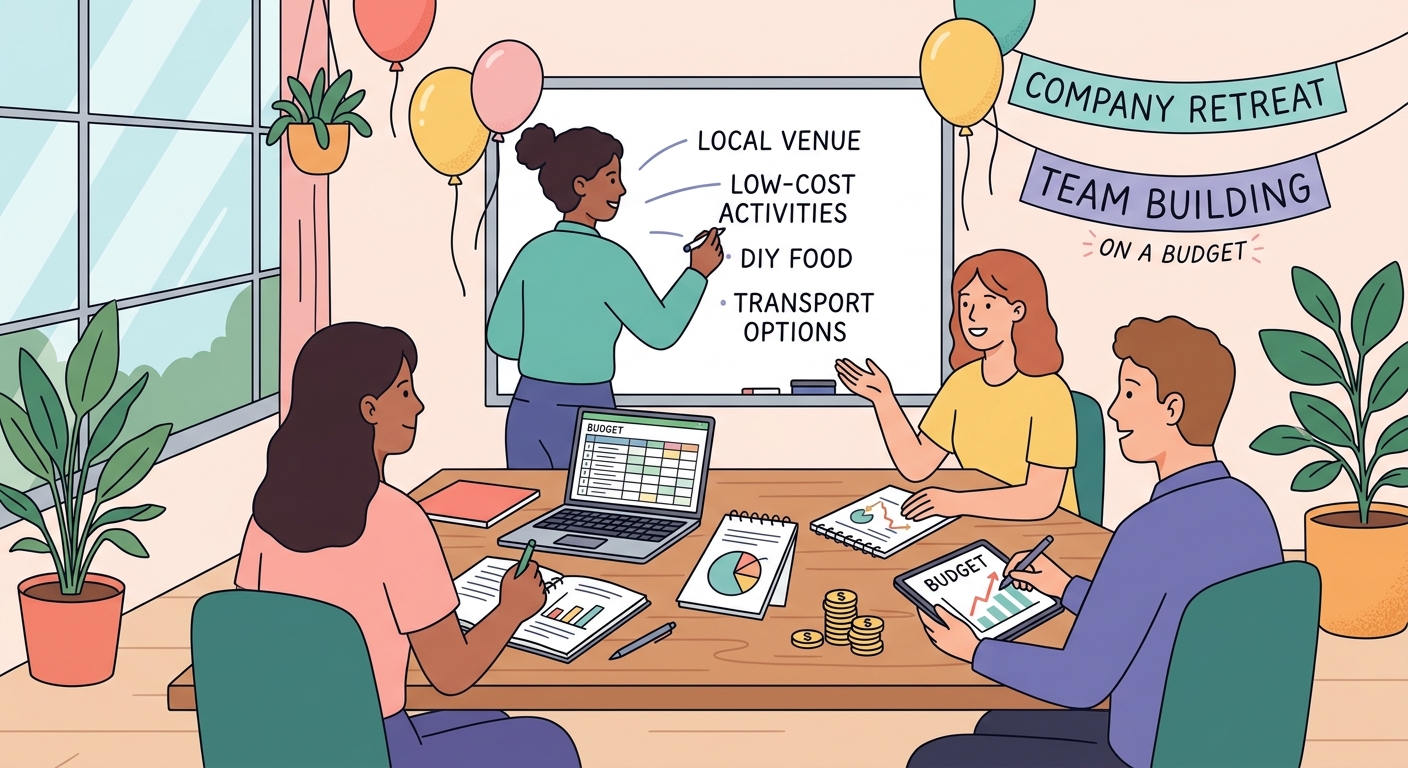
The retreat activities that teams remember most rarely cost money. They cost creativity and intention.
Here are activities that work without a budget:
- Lightning talks: Each team member prepares a 5-minute presentation on anything they’re passionate about (not work related). You learn who breeds exotic fish, who’s training for a marathon, who makes pottery.
- Problem solving sessions: Break into small groups and tackle a real company challenge. The best ideas often come from people outside the usual decision-making circle.
- Skill shares: Your designer can teach basic Figma skills. Your developer can explain how the backend actually works. Your sales person can share negotiation tactics.
- Outdoor activities: Hiking, beach walks, park games. Free, healthy, and conducive to natural conversation.
“The retreats I remember most didn’t have expensive speakers or elaborate activities. They had unstructured time where I actually got to know my coworkers as humans, not just Slack avatars.” – Sarah Chen, Product Manager
Create a realistic budget breakdown
Let’s talk numbers. Here’s what a budget-conscious retreat for 12 people might actually look like:
| Category | Budget Option | Cost per Person | Total |
|---|---|---|---|
| Accommodation (2 nights) | Large vacation rental | $67 | $800 |
| Food | Groceries + 2 meals out | $75 | $900 |
| Transportation | Carpooling | $20 | $240 |
| Activities | Free/low-cost options | $15 | $180 |
| Supplies | Meeting materials, snacks | $10 | $120 |
| Total | $187 | $2,240 |
Compare that to a traditional hotel-based retreat at $400 to $600 per person. You’re saving 60 to 70% while potentially creating a more intimate, memorable experience.
Adjust these numbers for your team size and location, but the principle holds: accommodation and food are your big levers.
Time your retreat to maximize value and minimize cost
Timing affects everything from venue availability to team energy levels.
Avoid these expensive periods:
– Summer vacation months (June through August)
– Major holiday weeks
– School spring break windows
– Peak conference seasons in your industry
Target these windows instead:
– Late September through early November
– January through March (except holiday weekends)
– Midweek blocks (arrive Tuesday evening, leave Thursday afternoon)
A Wednesday retreat also means you’re only “losing” one full work day instead of disrupting an entire week. Your finance team will appreciate that calculation.
Handle food without hiring a catering company
Food is where budgets spiral unnecessarily. Catered meals run $30 to $75 per person per meal. For a two-day retreat with six meals, that’s potentially $450 per person just for food.
Try this approach instead:
Breakfast: Stock the kitchen with bagels, fruit, yogurt, coffee, and juice. Cost: $8 per person per day.
Lunch: Build-your-own sandwich bar or taco station. Lay out ingredients, let people customize. Cost: $12 per person.
Dinner: Either cook together (team building bonus!) or go to a casual local restaurant. Cost: $25 to $35 per person.
Snacks: Bulk nuts, fruit, chips, and drinks available all day. Cost: $5 per person per day.
Total food cost: roughly $75 per person for an entire weekend versus $200+ for catering.
Cooking together also creates natural bonding moments. There’s something about chopping vegetables and debating seasoning choices that breaks down workplace hierarchies.
Get your team involved in the planning
You don’t have to figure everything out alone. Your team has ideas, skills, and often local knowledge you lack.
Send a survey asking:
– What they hope to get from the retreat
– Any dietary restrictions or accessibility needs
– Skills they’d be willing to share
– Local spots they’d recommend
When people contribute to planning, they’re more invested in the outcome. Plus, you might discover that someone on your team has a friend with a lake house, or knows a great hiking trail, or makes incredible playlists for road trips.
Delegate specific responsibilities. Someone can handle the grocery shopping list. Someone else can organize transportation logistics. Another person can create the schedule.
This distributes the work and makes the retreat feel like a team effort rather than a top-down mandate.
Avoid these common budget killers
Smart planning means knowing where money disappears without adding value.
Last-minute bookings: Prices jump when you book with less than six weeks’ notice. Plan early.
Overcomplicating the agenda: Packing every hour with structured activities sounds productive but exhausts people. Why your remote meetings feel exhausting applies to retreats too. Build in downtime.
Unnecessary swag: Branded water bottles and t-shirts feel obligatory but rarely get used. Skip them or choose one meaningful item instead of five forgettable ones.
Transportation chaos: Uncoordinated travel means some people rent cars while others Uber, multiplying costs. Organize carpools or rent one van.
Ignoring free amenities: You’re paying for that venue’s fire pit, game room, or trail access. Use them instead of paying for outside entertainment.
Measure success beyond the price tag
The retreat is over. How do you know if it worked?
Don’t measure success by how much you spent or how Instagram-worthy the location was. Measure it by outcomes tied to your original goals.
Send a post-retreat survey asking:
– What was the most valuable part?
– What would you change?
– Do you feel more connected to teammates?
– Did you learn something useful?
– Would you want to do this again?
Track softer metrics too. Do people seem more engaged in meetings afterward? Are cross-team collaborations happening more naturally? Is Slack conversation more friendly and less transactional?
A $2,000 retreat that strengthens your team culture and reduces turnover delivers far more value than a $10,000 retreat that people tolerate but don’t remember.
Make your budget retreat better than their expensive one
Company retreats don’t fail because of small budgets. They fail because of unclear goals, poor planning, and the assumption that money solves everything.
The constraints of a limited budget often force creativity that makes retreats better. You can’t rely on expensive activities to create engagement, so you focus on genuine connection instead. You can’t book the luxury resort, so you find the quirky lake house that actually encourages conversation.
Your team doesn’t need a corporate event. They need real time with real people they work with every day but barely know. That doesn’t require a big budget. It requires intention, planning, and the willingness to try something different.
Start small. Plan well. Focus on what actually matters. Your first retreat might not be perfect, but it can absolutely be meaningful. And that’s worth more than any line item in a budget spreadsheet.
