Remote teams don’t bond over Slack messages and monthly video calls. They bond when they share meaningful experiences that reveal who they really are beyond their job titles. The problem? Most team retreat activities feel forced, awkward, or like they were designed for a corporate training video from 1997. Your distributed team deserves better than trust falls and two truths and a lie.
Successful team retreat activities for remote teams prioritize [psychological safety](https://en.wikipedia.org/wiki/Psychological_safety), shared vulnerability, and collaborative problem solving over generic games. The best activities create space for authentic connection through structured storytelling, hands-on challenges, and reflective exercises that translate directly to improved daily collaboration. Focus on activities that build trust through action, not forced conversation.
Why remote teams need different retreat activities
Remote workers spend most of their time in carefully curated video squares. They control their lighting, their background, and exactly how much of themselves they share. That’s efficient for getting work done, but it creates distance.
Traditional office teams build rapport through hallway conversations, lunch runs, and overhearing each other’s phone calls. Remote teams miss all of that ambient connection.
Your retreat is the rare opportunity to break through those digital barriers. But handing out name tags and playing charades won’t cut it.
The activities that work for remote teams share three characteristics:
- They create shared experiences that people reference later
- They reveal authentic personality traits and working styles
- They build skills that transfer to virtual collaboration
Planning your first retreat takes strategy beyond just booking a venue. How to plan your first company retreat without breaking the budget covers the logistics that make or break these events.
Activities that reveal authentic working styles
Personal user manual workshop
Each team member creates a one-page guide to working with them. Not a resume. A manual.
They answer questions like: When do I do my best thinking? What drains my energy? How do I prefer to receive feedback? What assumptions do people make about me that are wrong?
Everyone presents their manual in small groups of three to four people. Then the whole team creates a shared document with everyone’s manuals for future reference.
This works because it gives people permission to state their needs directly instead of hoping colleagues will guess correctly.
Budget 90 minutes for creation and sharing.
Collaboration style mapping
Set up four corners of the room with signs: Thinker, Doer, Feeler, Organizer.
Present a realistic work scenario your team faces regularly. Ask everyone to move to the corner that represents their first instinct for approaching that problem.
Once grouped, each corner discusses their approach for five minutes and presents to the whole group.
Run this three times with different scenarios. People will move to different corners based on the context.
The insight comes from seeing that your quiet developer becomes a Doer when discussing technical architecture, but a Thinker when planning marketing campaigns. These nuances get lost on video calls.
Trust-building through shared vulnerability
Failure resume session
Everyone writes down three professional failures or mistakes that taught them something valuable. Real ones. Not humble brags disguised as failures.
In groups of four, people share one failure and what they learned. The group asks follow-up questions.
After 30 minutes, bring everyone together. Ask volunteers to share the most interesting failure they heard from someone else (with that person’s permission).
This activity works because it normalizes failure and creates space for people to be human. When your engineering lead admits they once pushed broken code to production, junior developers feel safer asking questions.
“The teams that perform best are not the ones that never fail. They’re the ones where people feel safe talking about failure without fear of judgment or punishment.” – Research from Google’s Project Aristotle
Values excavation exercise
Give everyone a list of 50 work values (autonomy, innovation, stability, recognition, learning, etc.).
Step one: Circle your top ten values.
Step two: Narrow to your top five.
Step three: Rank those five in order.
Partner up with someone you don’t work with directly. Each person explains why their number one value matters to them. Share a story that illustrates that value in action.
Rotate partners three times.
This creates understanding about what motivates different team members. Your product manager who always pushes for more user research? Learning is probably their top value. Your designer who questions every process? Autonomy.
When you understand someone’s core values, their behavior makes more sense.
Collaborative challenges that require real teamwork
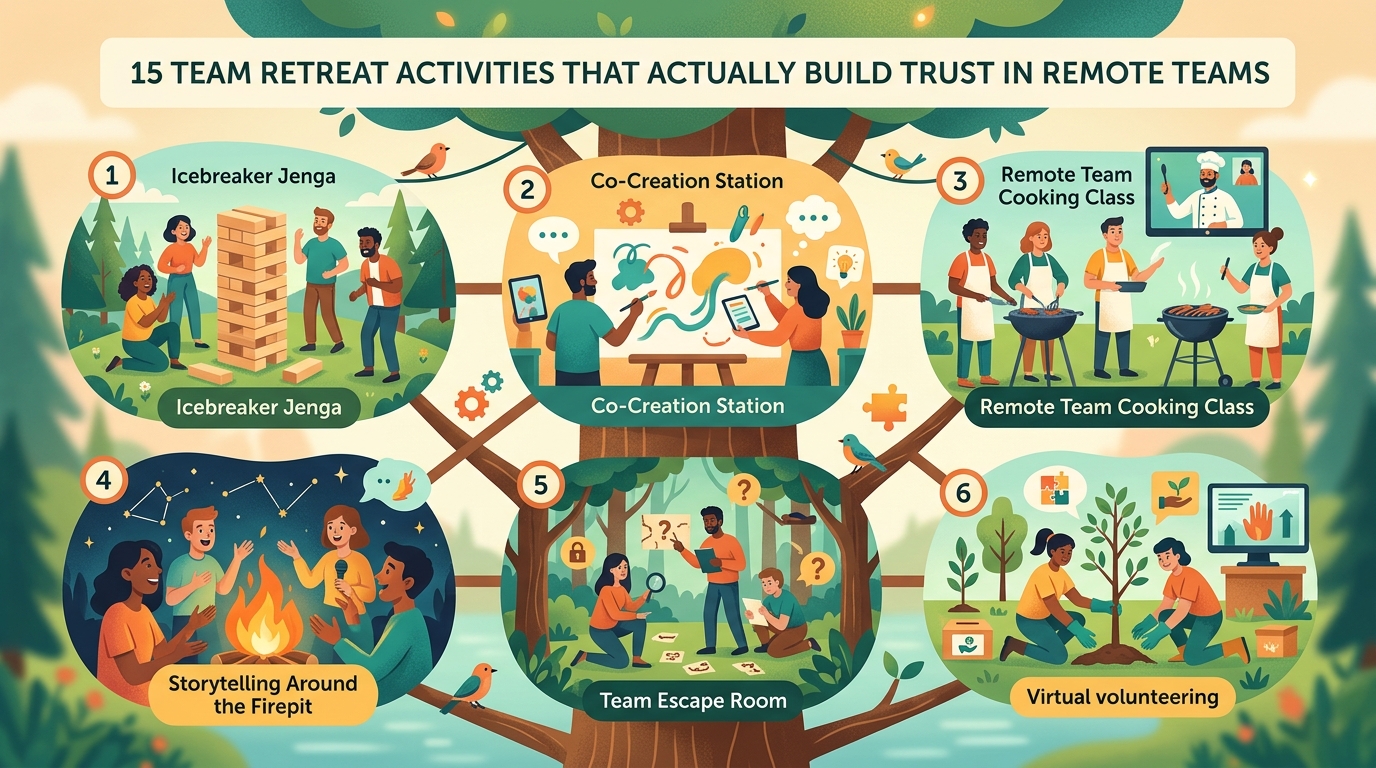
Escape room with a twist
Standard escape rooms work fine, but add this element: assign roles that flip people’s normal work responsibilities.
Your detail-oriented project manager becomes the creative brainstormer. Your big-picture CEO becomes the note-taker tracking every clue.
Debrief afterward about what it felt like to work outside their comfort zone and what they noticed about how others approached problems.
Build something together
Split into teams of four to five people. Each team gets identical supplies: cardboard, tape, string, paper clips, markers.
The challenge: Build a structure that can hold a tennis ball three feet off the ground for 30 seconds. You have 45 minutes.
The catch: For the first 15 minutes, nobody can talk. Communication happens through gestures and drawings only.
After 15 minutes, talking is allowed.
This simulates the communication challenges of remote work. The silent phase mirrors asynchronous work. The talking phase mirrors synchronous collaboration.
Teams that succeed learn to over-communicate and confirm shared understanding. Teams that struggle usually discover they made assumptions about what others were thinking.
Activities that translate to daily remote work
Asynchronous problem solving practice
Present a real business challenge your company faces. Something meaty that doesn’t have an obvious answer.
Teams of five work together to develop a solution, but here’s the structure:
- Everyone gets ten minutes to write down initial thoughts individually
- Pass papers to the right. Spend five minutes reading and adding to someone else’s ideas
- Rotate twice more
- Come together as a team to synthesize the best ideas into a proposal
- Present to the larger group
This mirrors how remote teams work asynchronously between time zones. It rewards clear written communication and building on others’ ideas.
Communication clarity challenge
Pair up. One person gets a complex diagram or pattern. The other person gets a blank paper and pen.
The person with the diagram must describe it clearly enough that their partner can recreate it. They cannot show the diagram. Their partner cannot ask clarifying questions.
After five minutes, compare results. Switch roles with a new diagram.
Then do it again, but this time questions are allowed.
The difference between the two rounds is dramatic. It illustrates why video meetings that allow real-time questions are valuable for complex topics, even though they’re exhausting.
Reflective activities that create lasting impact
Peak moments timeline
Everyone draws a timeline of their career. They mark three to five peak moments where they felt most engaged, proud, or energized at work.
In small groups, people share their timelines and explain what made those moments meaningful.
The group identifies common themes. Usually patterns emerge: autonomy, mastery, purpose, recognition, or collaboration.
This helps team members understand what conditions help their colleagues do their best work. That insight carries back to daily collaboration.
Future backwards planning
Imagine it’s one year from today. Your team just had the best year ever. Everyone feels connected, productive, and excited about their work.
Write down specifically what happened to make that true. What changed? What did you start doing? What did you stop doing?
Share in groups and identify the top three changes that appeared most frequently.
These become your team’s actual goals for the next year. Not imposed from above, but co-created based on what people actually want.
Making activities stick after the retreat
The best retreat activities create reference points your team uses for months afterward.
When someone on your team is struggling with feedback, they remember the personal user manuals. When a project hits a roadblock, someone references the problem-solving approaches from the collaboration mapping.
Build in these follow-up mechanisms:
- Create a shared photo album from the retreat that people can access anytime
- Schedule a one-month post-retreat call to discuss what’s working differently
- Reference specific activities in team meetings when relevant situations arise
- Add key insights to your team documentation
The venue matters too. Choosing the right coworking space for your retreat affects how comfortable people feel participating in vulnerable activities.
Matching activities to team maturity
Not every activity works for every team. A newly formed remote team needs different exercises than a group that’s worked together for three years.
| Team Stage | Best Activity Types | What to Avoid |
|---|---|---|
| Newly formed (0-6 months) | Structured sharing, skill mapping, collaboration practice | High vulnerability exercises, competitive challenges |
| Developing (6-18 months) | Problem solving, values work, working style reveals | Overly personal sharing, activities requiring established trust |
| Mature (18+ months) | Strategic planning, failure discussions, future visioning | Basic introductions, surface-level icebreakers |
New teams need structure and clear guidelines. They’re still figuring out social norms and who’s safe to be authentic with.
Mature teams can handle more ambiguity and vulnerability. They’ve earned the right to have harder conversations.
Common mistakes that kill retreat activities
Even well-designed activities fail when facilitators make these errors:
Forcing participation in sharing exercises. Always offer an opt-out. “You can share or pass” gives people control.
Skipping the debrief. The activity itself matters less than the conversation afterward about what people noticed and learned.
Packing the schedule too tightly. The best connections happen in the margins. Leave space for unstructured time.
Ignoring different personality types. Introverts need processing time. Extroverts need discussion time. Build in both.
Making everything a competition. A few competitive elements work fine, but constant competition creates stress instead of connection.
Using the same activities every retreat. What worked brilliantly once becomes stale the third time.
The teams that get retreats right treat them as strategic investments, not just fun breaks from work. They choose activities intentionally based on specific trust gaps they’re trying to close.
Adapting activities for hybrid teams
Hybrid teams face unique challenges. Some people see each other daily at the office. Others join via video.
For hybrid teams, retreat activities should specifically address that split experience:
- Pair remote-only employees with office-based employees for partner activities
- Rotate team compositions so people work with different combinations
- Include activities that simulate remote collaboration challenges
- Discuss openly how to make hybrid meetings more inclusive
Designing hybrid work schedules that feel fair requires understanding these different experiences.
Measuring whether activities actually worked
Trust is hard to measure, but you can track indicators:
- Do people reference the retreat in daily work conversations?
- Are team members more willing to ask for help?
- Do people share personal updates more freely in team channels?
- Has conflict resolution improved?
- Do cross-functional projects move faster?
Send a simple survey two weeks after the retreat and again at three months. Ask what activities people remember and what’s changed in how they work together.
The activities that stick are the ones people bring up spontaneously months later.
Creating connection that lasts beyond the retreat
Team retreat activities for remote teams work best when they’re part of a larger strategy for building connection, not a once-a-year event that’s supposed to fix everything.
The retreat creates momentum. Your job is to maintain it through intentional practices: regular video coffee chats, celebrating wins publicly, creating space for non-work conversation, and continuing to prioritize psychological safety.
The trust you build during two days together compounds when you nurture it consistently. The activities give you a foundation. What you build on that foundation determines whether your team actually feels connected or just has nice memories of that one time you did an escape room together.
Choose activities that reveal who your people really are. Create space for authentic moments. Build skills that transfer to daily work. That’s how retreat activities create lasting change instead of temporary good vibes.
