
Your engineering team just lost three hours of productivity because someone asked a question that was answered two months ago in a Slack thread no one can find. The new hire scheduled five separate meetings to understand a deployment process that should have taken ten minutes to read. Your best developer spent half her morning explaining the same architecture decision for the third time this week.
Sound familiar?
A documentation first culture prioritizes writing things down before talking about them. It reduces meeting overhead, preserves [institutional knowledge](https://en.wikipedia.org/wiki/Institutional_knowledge), and empowers distributed teams to work [asynchronous](https://en.wikipedia.org/wiki/Asynchronous_communication)ly across time zones. This approach requires intentional systems, clear ownership, and consistent habits that make documentation the default rather than an afterthought.
What documentation first culture actually means
Documentation first culture means you write it down before you talk about it. Not after. Not eventually. Before.
It means decisions get recorded in searchable formats. Processes live in maintained wikis. Architecture choices include written rationales. Meeting agendas exist before the calendar invite goes out.
This isn’t about creating more bureaucracy. It’s about respecting everyone’s time.
When your team spans three continents, real-time communication becomes expensive. Someone always misses the meeting. Someone always sleeps through the announcement. Someone always joins three months after the decision was made and has no context.
Documentation first culture solves this by making written communication the primary channel and synchronous meetings the exception.
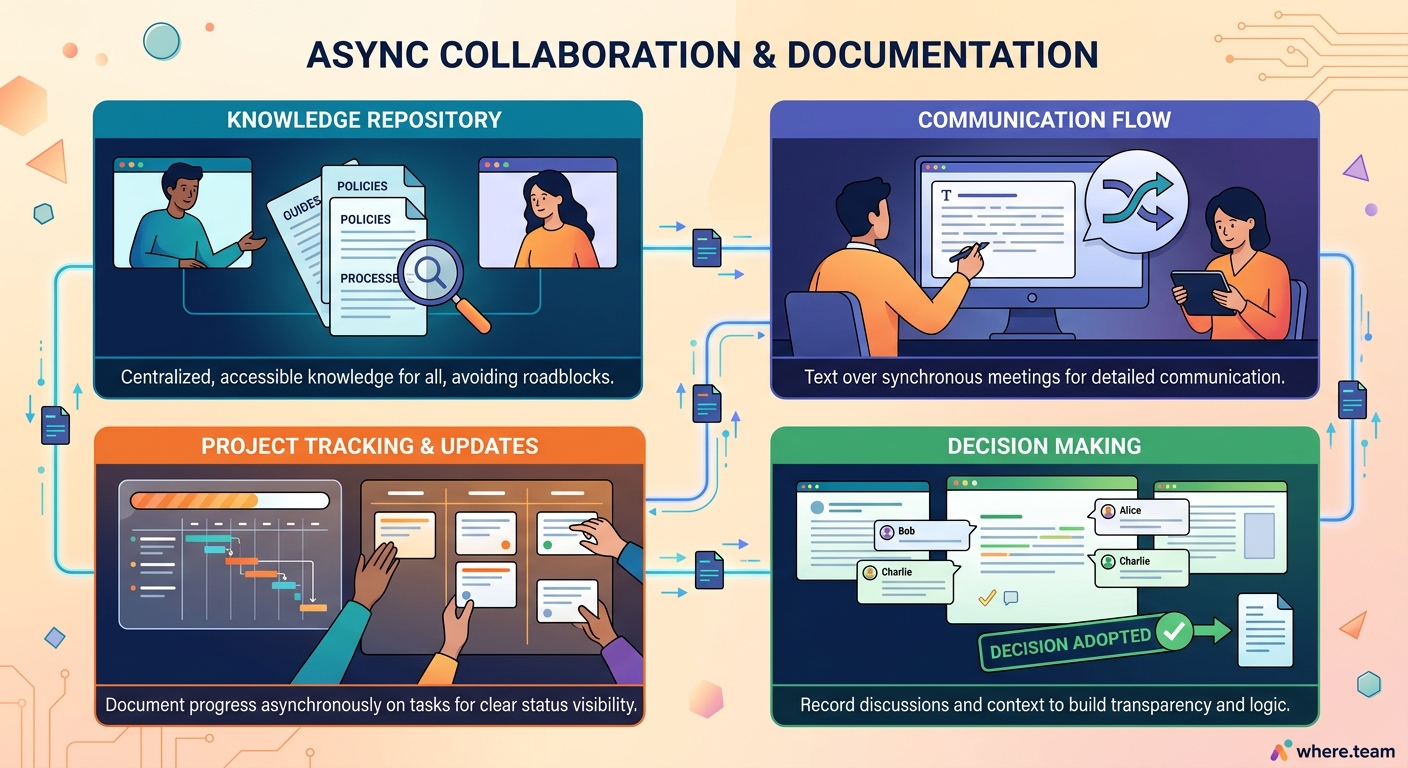
The difference shows up in daily work. Instead of scheduling a meeting to explain a feature, you write a brief spec. Instead of verbal onboarding, you maintain updated guides. Instead of tribal knowledge locked in senior engineers’ heads, you build a shared knowledge base everyone can access.
Why distributed teams need this more than anyone
Remote work exposes the cracks in oral culture fast.
In an office, you can tap someone on the shoulder. You overhear conversations. You absorb context through proximity. None of that works when your team is distributed.
Distributed teams face unique challenges that documentation directly addresses:
- Time zone differences make synchronous communication painful
- New team members can’t shadow experienced colleagues
- Knowledge silos form around individuals rather than topics
- Repeated questions drain productivity from senior staff
- Context gets lost when people leave or change roles
Without strong documentation practices, remote teams burn hours in unnecessary meetings trying to share information that should live in permanent, searchable formats.
The math is simple. Writing something once and letting fifty people read it beats explaining it fifty times in separate conversations.
Building blocks of a documentation first culture
You need four foundational elements to make this work.
Centralized knowledge base
Pick one source of truth. Not three wikis, five Google Drive folders, and a Notion workspace. One place where documentation lives.
This could be Confluence, GitBook, Notion, or even a well-organized GitHub wiki. The tool matters less than the commitment to using it consistently.
Your knowledge base should be:
- Searchable across all content
- Version controlled to track changes
- Accessible to everyone who needs it
- Organized by topic, not team structure
- Integrated with your daily workflow
Clear ownership model
Every document needs an owner. Not a team. Not a department. A specific person responsible for keeping it current.
Ownership doesn’t mean that person writes everything. It means they ensure accuracy, coordinate updates, and respond when something needs clarification.
Without ownership, documentation rots. Six months later, no one knows if the deployment guide reflects current reality or describes a process you abandoned last quarter.
Templates for common scenarios
Decision records, project specs, incident reports, onboarding guides. These shouldn’t start from blank pages.
Templates reduce friction. They answer “what should I include?” before anyone asks. They ensure consistency across documents so people know where to find specific information.
Good templates include prompts, not just section headers. “Describe the problem this solves” works better than “Problem Statement.”
Documentation time in workflows
If writing documentation feels like extra work, it won’t happen.
Build it into existing processes. Code reviews include documentation updates. Project kickoffs start with spec writing. Incident response ends with postmortem documentation.
The goal is making documentation creation feel like a natural step, not an additional burden.
Practical steps to implement documentation first practices
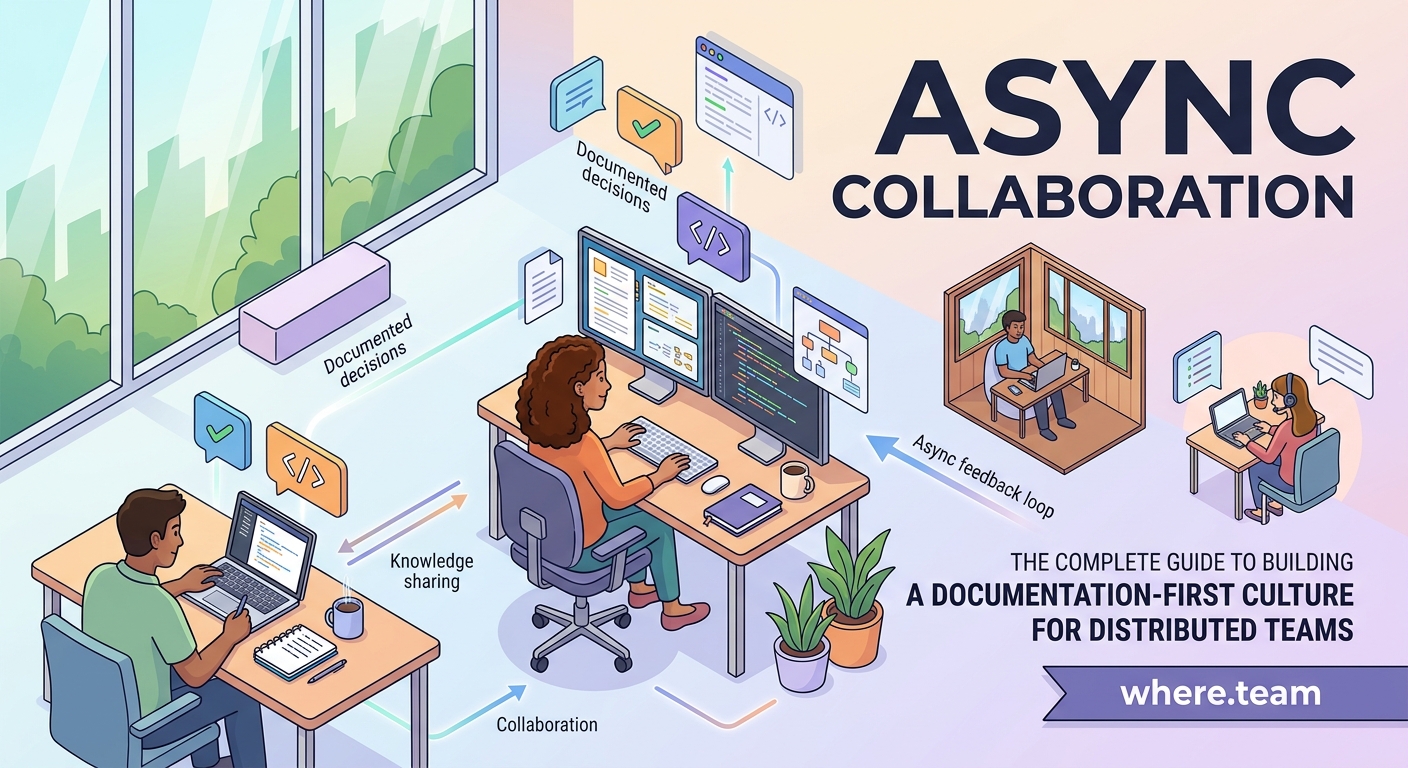
Here’s how to actually build this culture, step by step.
-
Start with decision records. Every significant decision gets documented with context, options considered, and rationale. This creates immediate value and establishes the habit.
-
Document your documentation process. Write a guide explaining where things go, how to structure content, and who maintains what. Make the meta-documentation excellent.
-
Create an onboarding checklist. New hires should be able to answer 80% of their questions by reading documentation. Track which questions still require meetings and document those answers.
-
Establish a weekly documentation hour. Block time specifically for writing and updating docs. Make it a team ritual, not individual homework.
-
Implement a “docs or it didn’t happen” rule. Decisions made in meetings don’t count until someone writes them down. No meeting notes means no decision.
-
Assign documentation champions. Identify people who naturally write things down and empower them to model good practices.
-
Review and retire outdated content. Schedule quarterly audits to update or archive old documentation. Outdated docs are worse than no docs.
Common mistakes that kill documentation efforts
Most documentation initiatives fail for predictable reasons.
| Mistake | Why it fails | Better approach |
|---|---|---|
| Waiting until projects finish | Documentation becomes reconstruction, not recording | Write as you go, treating docs as project deliverables |
| Making it optional | Only enthusiasts document, creating gaps | Build documentation requirements into definitions of done |
| Perfectionism | People delay publishing until docs are flawless | Ship drafts early, iterate based on feedback |
| No maintenance plan | Docs become outdated and lose trust | Assign owners and schedule regular reviews |
| Wrong level of detail | Either too vague or exhaustively detailed | Focus on decision context and high-level flows |
| Siloed by team | Each group maintains separate documentation | Organize by topic and user journey, not org chart |
The perfectionism trap deserves special attention. Incomplete documentation that exists beats perfect documentation that never gets written.
Publish the draft. Add a note saying “this is in progress, here’s what we know so far.” Let people contribute improvements.
“The best documentation is the documentation that actually gets used. That means it needs to be good enough to be helpful, findable when people need it, and maintained well enough to stay trustworthy. Perfect documentation that takes three months to write fails on all three counts.” – Engineering leader at a 200-person distributed company
Making documentation discoverable and useful
Writing documentation solves half the problem. The other half is making sure people can find and use it.
Search must work
If your team can’t find documentation in under 30 seconds, they’ll ask someone instead. Invest in search functionality. Use consistent terminology. Tag content appropriately.
Structure matters more than volume
A well-organized 50-page knowledge base beats a chaotic 500-page one. Create clear hierarchies. Use descriptive titles. Maintain a table of contents.
Link liberally
Connect related documentation. When you mention a process, link to its guide. When you reference a decision, link to the decision record.
Internal linking creates a knowledge web that helps people discover related information naturally.
Keep it scannable
Use headings, bullet points, and tables. Break up walls of text. Put the most important information first.
People skim documentation looking for specific answers. Make that easy.
Update the classics
Some documents get referenced constantly. Deployment guides, architecture overviews, coding standards. These deserve extra attention.
Schedule regular reviews for high-traffic documentation. Keep it current. Add examples. Clarify confusing sections based on questions you receive.
Measuring whether it’s working
You need signals to know if your documentation first culture is taking hold.
Track these metrics:
- Number of “where is this documented?” questions in chat
- Time to productivity for new hires
- Percentage of meetings with pre-written agendas
- Documentation page views and search queries
- Ratio of synchronous to asynchronous communication
- Number of repeat questions about the same topics
The goal isn’t perfection. It’s progress. You want to see the trend moving toward more documentation, fewer interruptions, and faster onboarding.
Qualitative feedback matters too. Ask your team:
- Can you find answers without asking someone?
- Do you feel confident documenting your own work?
- Has documentation reduced your meeting load?
- Do you trust the documentation to be current?
Handling resistance and building momentum
Not everyone will embrace documentation first culture immediately.
Some engineers see writing as a distraction from “real work.” Some managers worry it will slow down decision-making. Some team members genuinely prefer talking things through.
Address resistance directly:
For the “documentation takes too long” crowd: Show them how much time they spend answering the same questions repeatedly. Calculate the time investment of writing once versus explaining ten times.
For the “we move too fast to document” group: Point out that moving fast without documentation means constantly relearning and repeating mistakes. Speed without memory isn’t sustainable.
For the “I’m not a good writer” objection: Emphasize that clear documentation beats elegant prose. Bullet points and screenshots work fine. Provide templates and examples.
For the “meetings are faster” believers: Acknowledge that initial documentation takes longer than a meeting. Then show how it pays dividends every time someone references it instead of scheduling another meeting.
Building momentum requires celebrating wins. When someone solves a problem using documentation instead of asking for help, highlight it. When a new hire onboards faster because of great docs, share that success.
Make documentation contributions visible. Some teams add documentation metrics to performance reviews. Others create recognition programs for exceptional documentation.
Integration with remote work logistics
Documentation first culture connects directly to how distributed teams coordinate their physical presence.
When your team does gather for quarterly meetups in coworking spaces, strong documentation makes those sessions more valuable. Instead of using precious in-person time to explain basic context, you can focus on strategic discussions and relationship building.
The same principle applies to company retreats. When everyone arrives with shared context from documentation, you can use retreat time for collaborative work that truly benefits from face-to-face interaction.
Hybrid work schedules work better when documentation reduces the need for everyone to be present simultaneously. Team members can contribute asynchronously, reviewing and commenting on documents regardless of when or where they work.
Even the choice between coworking day passes and monthly memberships becomes easier when your documentation culture reduces the need for constant in-person coordination.
Tools that support documentation first workflows
The right tools make documentation first culture easier to maintain.
Knowledge bases: Notion, Confluence, GitBook, and Coda all work well. Choose based on your team’s existing tools and workflows.
Decision logging: Architecture Decision Records (ADRs) can live in your codebase as markdown files. Tools like ADR Tools help structure and search them.
Async communication: Loom for video documentation, Slack threads for discussions that should be preserved, and email for formal announcements.
Diagram tools: Mermaid, Excalidraw, and Lucidchart help create visual documentation that explains complex systems better than text alone.
Documentation testing: Vale and other linters can check documentation for consistency, clarity, and adherence to style guides.
The tool ecosystem matters less than the commitment to using whatever tools you choose consistently.
Evolving your documentation culture over time
Documentation first culture isn’t a project with an end date. It’s an ongoing practice that evolves with your team.
As you grow, your documentation needs change. A 10-person team can get away with informal documentation. A 100-person team needs more structure, templates, and governance.
Regular retrospectives help identify what’s working and what needs adjustment. Maybe your decision record template is too lengthy. Maybe your wiki organization doesn’t match how people actually search for information. Maybe certain types of documentation consistently go stale.
Stay flexible. The goal is useful documentation that serves your team, not documentation for its own sake.
Some teams start with lightweight practices and add structure as they scale. Others begin with more formal systems and simplify as they learn what actually gets used.
Both approaches work. The key is continuous improvement based on real usage patterns and feedback.
When documentation first culture truly clicks
You’ll know your documentation first culture has taken root when certain behaviors become automatic.
Someone proposes a meeting and the first question is “do we have a doc for this?” Engineers write specs before writing code. Product decisions include written rationale. New team members find answers in documentation before asking in chat.
The culture shift shows up in small moments. A developer updates documentation as part of their pull request without being reminded. A manager shares a doc link instead of scheduling a meeting. A new hire compliments your onboarding materials.
These signals indicate that documentation has moved from an obligation to a habit. From something you should do to something you naturally do.
That’s when the real benefits compound. Knowledge accumulates instead of evaporating. Onboarding accelerates. Meetings decrease. Productivity improves.
The investment in building documentation first culture pays returns for years. Every document written today saves dozens of conversations tomorrow. Every process recorded preserves institutional knowledge that would otherwise walk out the door when someone leaves.
Making it stick for the long term
Documentation first culture requires ongoing commitment from leadership and consistent reinforcement across the team.
Leaders set the tone by modeling the behavior they want to see. When executives share written updates instead of calling meetings, it signals that documentation matters. When managers praise thorough documentation in performance reviews, it reinforces the value.
Make documentation part of your team’s identity. Talk about it in interviews. Include it in onboarding. Reference it in team values. Celebrate people who document well.
Build feedback loops that improve documentation quality over time. When someone can’t find information, that’s a signal to improve organization or search. When documentation proves inaccurate, that’s a signal to review maintenance processes.
The teams that succeed with documentation first culture treat it as a core competency, not a nice-to-have. They invest in it deliberately. They measure its impact. They refine their practices based on results.
Your distributed team deserves better than endless meetings and lost context. Start documenting first, and watch how much more your team can accomplish when knowledge flows freely across time zones, roles, and tenures.
