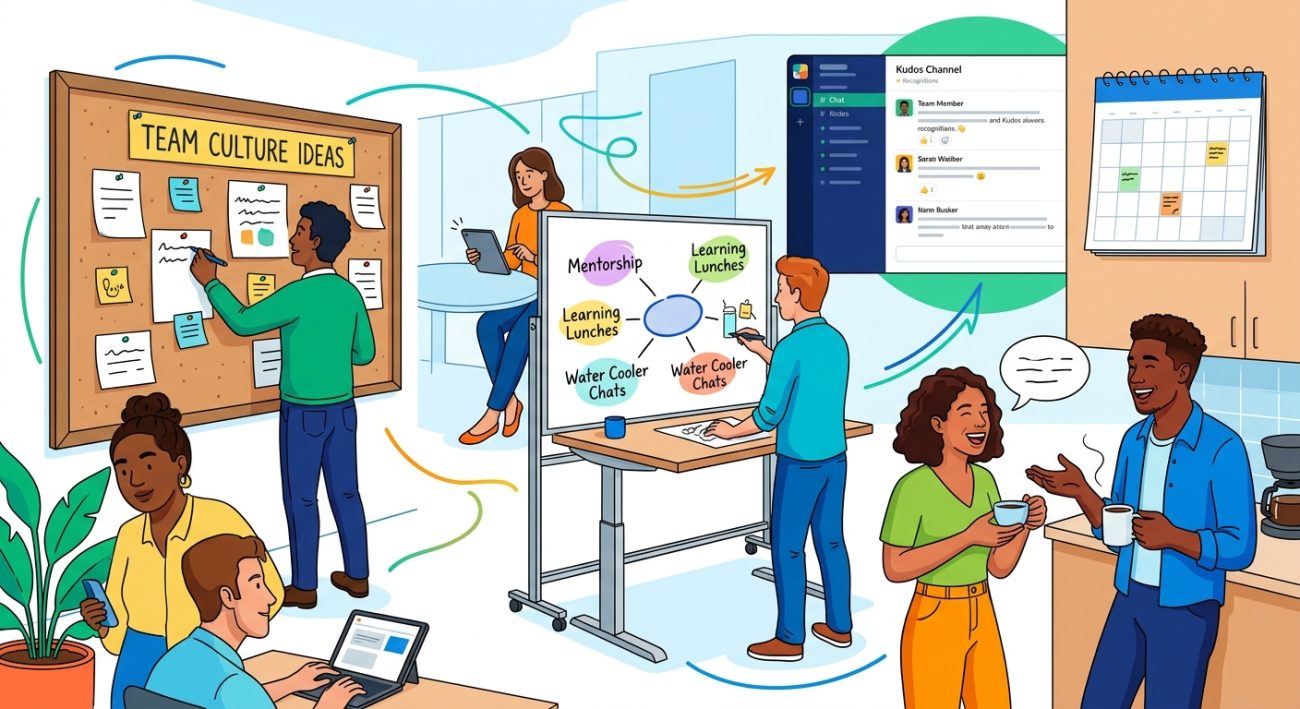
Your team already has too many meetings. You know it, they know it, and by this point the calendar notifications feel like a slow-moving threat. The idea of blocking off another hour for a virtual coffee chat or a mandatory ice-breaker session lands about as well as an unsolicited invitation to a Tuesday evening webinar. And yet the pressure to build team culture is real. Remote teams do drift apart. Relationships thin out when every interaction is task-focused. Something has to give, but that something does not have to be another block on Thursday afternoon.
Genuine team culture rarely comes from big scheduled events. It comes from small, repeated moments that happen in between.
Culture Builder’s Reality Check
- Culture is built through consistency and small moments, not scheduled events.
- Async rituals and lightweight touchpoints compound quietly over weeks and months.
- Structured activities work best when they slot into workflows that already exist.
Why Big Team Events Often Miss What They’re Aiming For
Mandatory fun is almost never fun. When a manager books a separate calendar slot for a virtual team activity and marks it as expected attendance, the message the team receives is not “we care about connection.” The message is “your time is mine to schedule.” Even with the best intentions, forced social time creates a low-level resentment that works directly against the culture you are trying to build.
There is a participation gap too. On any given team, some people genuinely enjoy structured social events. Others find them exhausting, whether because of their personality type, their home situation, their neurodivergence, or just how their day is going. A mandatory event quietly signals to those people that they do not quite fit the mold, which is the opposite of belonging. And without belonging, you do not have culture. You have a headcount.
Big events also fade fast. The warm feelings from a virtual games night or an offsite rarely persist past the following week. Without a consistent thread of smaller moments running through the in-between weeks, those bigger events become isolated islands with nothing connecting them over time.
What Small Moments Actually Do for a Team
Think about the colleagues you have felt most connected to over your career. The relationship that formed was almost never the result of a company retreat. It was a running joke in a group chat, a quick message after a rough presentation, a check-in about a hobby they mentioned in passing three weeks earlier. Small moments, repeated consistently over time, create the sense that your manager and teammates actually see you as a person rather than a job title.
Extensive employee engagement data shows that people who feel genuinely known by their teammates are more engaged, more productive, and far less likely to leave. The finding is not about grand events. It is about whether people feel that someone at work actually knows them beyond their deliverables and their availability in a shared calendar.
For managers, this is a useful reframe. The job is not to engineer fun. It is to create enough small openings that genuine connection can happen on its own terms, in its own time, without requiring a separate meeting invite to make it official.
Async Rituals That Compound Over Time
Async rituals are the underused workhorse of remote culture. They require almost no synchronous time, they are naturally opt-in without feeling exclusionary, and they build a visible thread of human connection that people can drop into at their own pace across any time zone.
A weekly async check-in channel, separate from project updates, is a reliable starting point. The prompt can be genuinely simple. “What’s one thing you’re looking forward to this week?” or “What did you do this weekend that had nothing to do with work?” These prompts get responses. People dip in, read a few replies, respond to one or two, and move on with their day. Over weeks, patterns emerge. You learn that someone on your team is training for a half marathon. You notice when someone who usually responds has gone quiet. That is real information, and it builds real familiarity without consuming a single minute of anyone’s scheduled time.
Async appreciation is another ritual worth building into your team’s rhythm. A dedicated channel where teammates can publicly thank a colleague for something specific costs nothing and takes about fifteen seconds to write. The effect, though, is disproportionate. Being seen by peers for something you did well is one of the most reliable drivers of belonging on a distributed team. A manager who posts one genuine, specific appreciation per week sets a tone that others tend to follow without being asked.
The key to making any async ritual stick is consistency without pressure. Post the prompt on the same day each week. Do not chase responses. Do not read anything into who participates and who does not. Just keep showing up, and eventually the ritual becomes part of how the team moves through the week rather than something that needs to be remembered or chased.
Lightweight Touchpoints That Already Exist on Your Calendar
You almost certainly have a standing weekly team meeting. That meeting probably opens with status updates and closes with action items. There is very little room in that structure for the kind of human exchange that actually builds culture over time.
A two-minute opening question changes that completely. Not a long exercise, not a structured activity with breakout rooms. Just one question at the start of the meeting that has nothing to do with work. “What’s something you learned this month that surprised you?” or “If you could swap roles with anyone on the team for a day, who would it be and why?” People answer in a sentence or two, the room warms up slightly, and the meeting moves on. Over months, those two-minute exchanges create a texture of familiarity that task-only meetings never produce.
One-on-ones are another underused opportunity. Most managers use them to check on deliverables and blockers, which is fine, but it leaves something significant on the table. Adding one or two non-work questions into a regular rotation turns a status call into an actual conversation. Asking how someone is feeling about their work, what is energizing them or draining them, or what they would like to be doing more of next quarter takes about four minutes and tells you more than a month of project updates. That distinction matters far more than most managers realize, and it costs nothing to change.
Structured Activities That Fit Into Existing Time
Sometimes you do want something with a bit more structure. A low-lift activity that gives people a shared experience without requiring a separate block on the calendar. These work best when they are genuinely optional, genuinely time-boxed, and genuinely interesting to more than one type of person on the team.
A team work game is a concrete option managers can introduce without sending a single calendar invite. Games designed specifically for work teams can drop into the last ten minutes of a meeting that runs short, or sit as a standing offer in a dedicated Slack channel for people to try when the moment suits them. No new invite required. No attendance tracked. Just an option that people take up when they feel like it, and pass on when they do not.
The same logic applies to asynchronous challenges, rotating show-and-tell segments within existing meetings, or informal open-door sessions that are not framed around deliverables. The pattern is identical in each case: make it available, keep it short, make it genuinely optional, and trust that people who want connection will find their way to it without being pushed.
Two Approaches to Team Culture: What Each One Actually Costs
| Factor | Big Scheduled Social Events | Small Embedded Moments |
|---|---|---|
| Calendar space required | One hour or more, a separate block for every person on the team | None, or two minutes folded into a meeting that already exists |
| Participation feel | Often perceived as mandatory even when framed as optional | Genuinely optional, with lower social pressure to perform |
| Manager setup time | Significant: planning, coordination, finding a slot that works for everyone | Minimal: a single Slack prompt or one opening question prepared in advance |
| Reach across time zones | Regularly excludes at least one person on a distributed team | Async-first options reach everyone regardless of location or schedule |
| Effect over six months | Fades between events without a consistent connecting thread | Compounds into genuine familiarity and a recognizable team identity |
The Culture That Grows in the Gaps
Culture is not something you schedule. It is something that accumulates. Every async check-in prompt that gets a genuine response, every two-minute opening question that makes someone laugh, every public appreciation message that says “I noticed what you did there” adds to a deposit that grows quietly in the background. Most of it is invisible until the moment it is not, and by then it has already become the thing holding your team together through the rough stretches.
The managers who build the strongest remote cultures are rarely the ones who plan the most events. They are the ones who understand that connection happens in the margins, and who protect those margins rather than filling them with yet another scheduled block.
Your calendar is already full. That is not a reason to give up on culture. It is the exact reason to stop looking for culture in your calendar at all.
