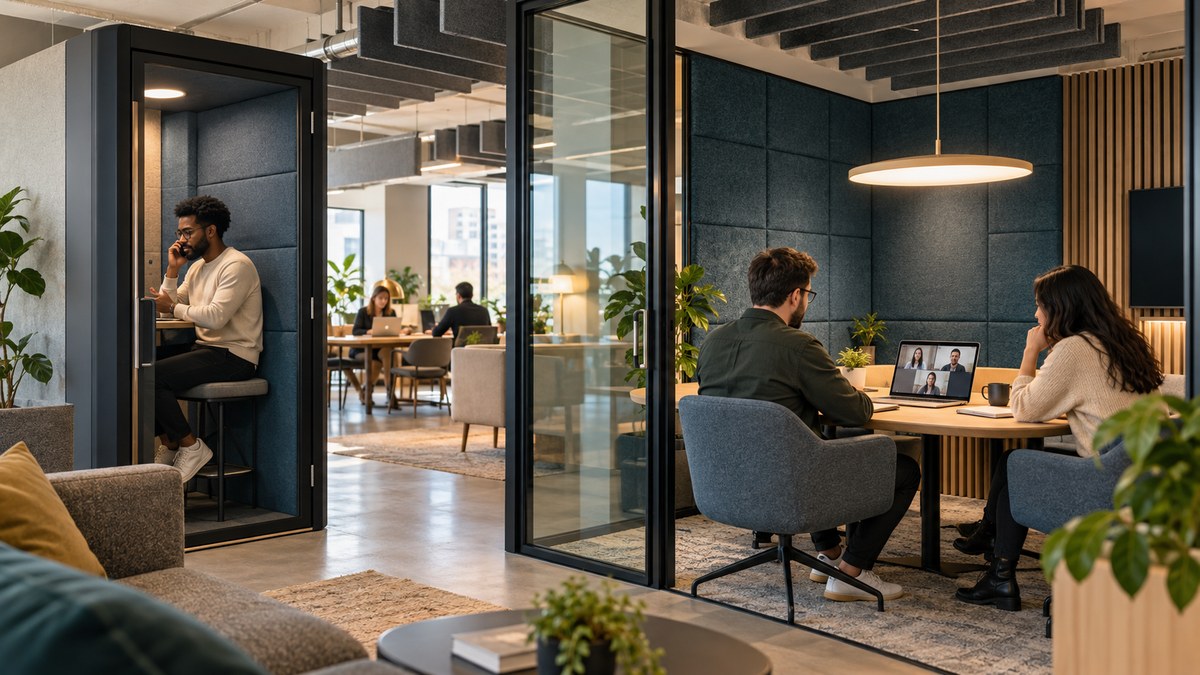
You are leading a hybrid team. One teammate is dialing in from a coworking space in Austin, another from a shared office in Chicago. Your client is on the line, and you need ten minutes of absolute silence. Then the espresso machine hisses. Someone takes a loud sales call two feet away. The person on your team starts apologizing, and the client loses focus.
That moment costs you credibility. It also costs you time.
Soundproof coworking spaces for hybrid teams are not a luxury anymore. They are a requirement. If your team uses shared workspaces, you need to know which locations offer real acoustic privacy, and which ones just have a frosted glass door and hope.
This guide will help you evaluate coworking spaces based on soundproofing, not just square footage or coffee quality. You will learn what to look for, what to ask before booking, and how to set your team up for success on every call.
Not all private offices in coworking spaces are quiet. Look for spaces that list STC ratings, have solid core doors, use acoustic panels, and separate meeting rooms from high traffic zones. Book a test call before committing. Your hybrid team needs soundproof coworking spaces that protect client conversations and team focus.
Why Standard Coworking Spaces Fail Hybrid Teams
Open plan coworking is great for serendipity. It is terrible for confidential calls.
Most coworking spaces were designed for solo freelancers wearing headphones. They were not designed for a distributed team that needs to run a quarterly review, a client pitch, or a strategy session with video on.
The problem is acoustic leakage. Sound travels under doors, through thin walls, and around poorly sealed windows. Even a dedicated meeting room can fail if it shares a wall with the kitchen or the main walkway.
For hybrid teams, the stakes are higher. You are not just managing one person’s focus. You are managing the perception of your company. If a client hears a blender in the background, they assume you are unprofessional. If your teammate cannot hear the discussion, they check out.
What Makes a Coworking Space Truly Soundproof
Real soundproofing is a system, not a single feature. Here is what to check when you evaluate a space.
1. Solid Core Doors
Hollow doors let sound pass through like paper. Look for solid core doors with proper weather stripping at the bottom. If you can see light under the door, you can hear noise through it.
2. Sealed Windows and Walls
Floor to ceiling glass looks nice but transmits sound. Some spaces solve this with double glazing or acoustic film. Others rely on heavy curtains. If the room is all glass, ask about the STC rating. A rating of 45 or higher is good for confidential conversations.
3. HVAC and Mechanical Noise
Sometimes the room is quiet, but the air vent sounds like a jet engine. Check the HVAC system. Is it loud? Does it cycle on and off during calls? This matters more than people realize.
4. Location Within the Space
A meeting room next to the front desk or the kitchen will never be quiet. Look for rooms tucked away from high traffic areas. Rooms on upper floors or away from common amenities tend to perform better.
5. Acoustic Treatment
Look for acoustic panels on the walls, carpeted floors, and ceiling baffles. These absorb sound inside the room and prevent echo. Without them, even a quiet room sounds hollow and unprofessional on a microphone.
How to Evaluate a Coworking Space for Soundproofing
Use this process before you book a space for your team.
-
Request a tour during peak hours. Do not visit at 10 AM on a Tuesday when the space is empty. Go at 2 PM on a Wednesday. Listen for chatter, phone calls, and kitchen noise.
-
Ask about STC ratings. Many premium spaces now advertise Sound Transmission Class ratings for their meeting rooms. If they do not know the number, that is a red flag.
-
Run a test call. Bring your laptop. Join a Zoom call with a teammate. Have them speak at a normal volume while you step outside the room. Can you hear them? If yes, the room is not soundproof enough.
-
Check the booking system. Can you book a room for a full hour without interruption? Some spaces kick you out after 30 minutes. That is not enough for a client meeting.
-
Read recent reviews for noise complaints. Filter coworking space reviews by keywords like “noise,” “loud,” “private,” and “call.” If multiple people mention bad acoustics, trust them.
Soundproof Coworking Spaces for Hybrid Teams: What to Look For
Here is a breakdown of the features that actually matter when you are choosing a space for your team.
| Feature | Why It Matters | What to Ask |
|---|---|---|
| Solid core door | Blocks sound better than hollow doors | “Is the door solid core or hollow?” |
| Acoustic panels | Reduce echo and absorb background noise | “What acoustic treatment does the room have?” |
| Separate HVAC zone | Prevents mechanical noise from other areas | “Does the room have its own thermostat?” |
| High STC rating | Measured soundproofing performance | “What is the STC rating of this room?” |
| Remote from high traffic | Less chance of sudden noise spikes | “Where is this room located in the space?” |
| Reliable booking system | Prevents mid-call interruptions | “How long can I book this room for?” |
Common Mistakes When Booking Coworking Spaces for Calls
Even experienced remote managers make these errors. Avoid them to protect your team’s focus.
-
Relying on “private office” labels. A private office is not the same as a soundproof office. Many private offices have thin walls and no acoustic treatment.
-
Ignoring the microphone test. Your laptop microphone picks up sound differently than your ears. Always test with the actual setup your team will use.
-
Booking during lunch rush. Even a well designed room can fail if people are yelling in the hallway. Book for times when the space is naturally quieter.
-
Assuming all phone booths are equal. Phone booths are great for solo calls. They are terrible for team meetings. Most are designed for one person and have poor ventilation.
-
Forgetting to check the internet. Soundproofing does not matter if the Wi-Fi drops during a presentation. Always test the connection speed in the room.
The Role of Acoustic Pods for Hybrid Teams
Many coworking spaces now install acoustic pods from brands like ROOM, Framery, and Jade. These are standalone booths with built in soundproofing, ventilation, and power.
For hybrid teams, these pods can be a lifesaver. They offer consistent acoustics across different locations. If your teammate in Denver and your teammate in New York both use the same brand of pod, you get a predictable experience.
However, pods have limits. Most fit one to four people. If your team is larger, you need a full meeting room. Also, some pods have poor ventilation. If the pod feels stuffy after ten minutes, your team will struggle to focus.
“The best acoustic pod is the one your team actually wants to sit in. If it feels like a closet, no amount of soundproofing will make it productive.” – Sarah Chen, remote team operations lead
How to Set Your Team Up for Soundproof Success
You cannot control every coworking space. But you can control how your team prepares.
-
Create a pre-call checklist. Include items like “test microphone,” “close the door,” “check for background noise,” and “mute notifications.”
-
Use a signal. If someone needs to step out of a soundproof room to take a call, they should know how to signal the team. A simple Slack status update works.
-
Have a backup plan. If the room is too loud, can the team move to a different area? Keep a list of backup spaces in each city.
-
Invest in good microphones. A directional microphone can reduce background noise even in a less than perfect room. Check out our guide on the best video conferencing cameras for remote teams in 2026 for compatible audio gear.
-
Train your team on meeting etiquette. Even in a soundproof room, people can interrupt. Teach your team to mute themselves when not speaking and to avoid side conversations.
Your Next Steps for Finding Soundproof Coworking Spaces
Start with the spaces your team already uses. Visit them during peak hours. Run a test call. Ask the hard questions about STC ratings and door construction.
If your current space does not meet the standard, look for alternatives. Many cities now have coworking spaces that cater specifically to hybrid teams. These spaces invest in acoustic design because they know their members need it.
You can also use booking platforms that filter by private offices and meeting rooms. Look for spaces that advertise “soundproofing” or “acoustic privacy” as a feature.
For more help, read our guide on how to evaluate coworking space internet reliability for remote team video calls. A quiet room with bad internet is still useless.
Making Soundproofing a Priority for Your Hybrid Team
Your team deserves to be heard clearly. Your clients deserve a professional experience. Soundproof coworking spaces for hybrid teams make both possible.
Do not settle for a space that looks good on Instagram but sounds bad on a conference call. The next time your teammate books a desk, ask them to check the door, listen for the HVAC, and run a quick audio test.
A few minutes of preparation can save you from a meeting that wastes everyone’s time. And in a hybrid world, protecting your team’s focus is one of the most important things you can do.
