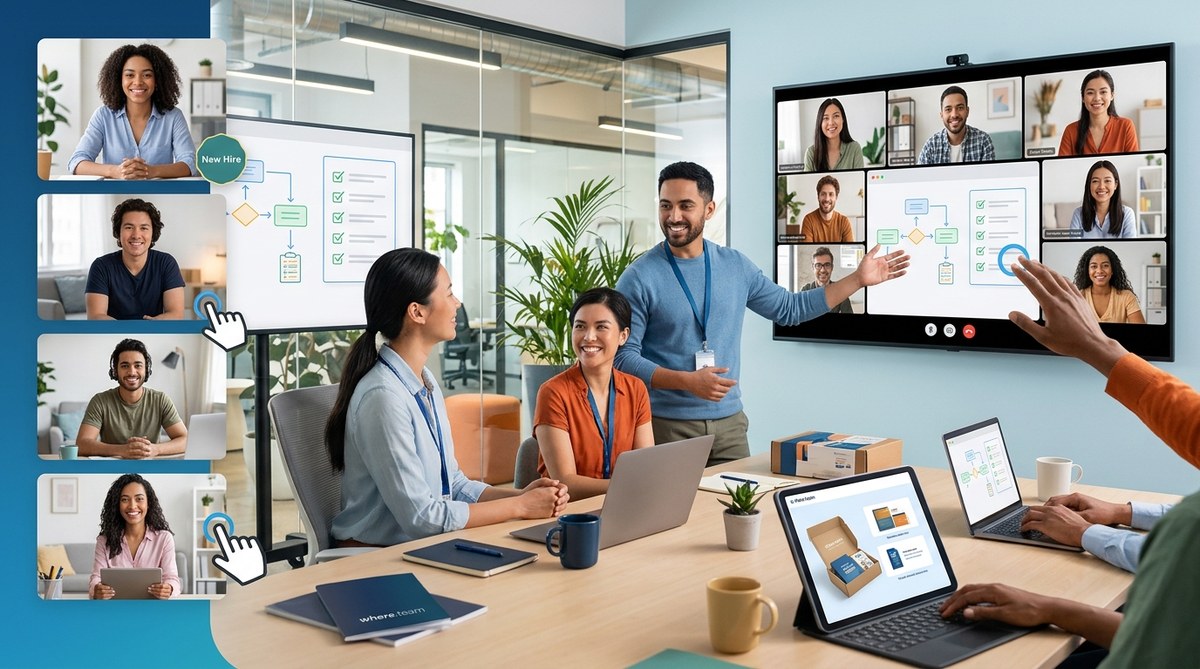
New hires walk into a lively office on their first day. They meet the team, grab coffee, and absorb the culture by osmosis. Meanwhile, their remote counterpart logs into a Zoom link, stares at a dark screen full of tiles, and tries to figure out which Slack channel is the right one. That gap is the single biggest threat to hybrid team onboarding in 2026, and it is widening every quarter.
If you manage a hybrid team, you already feel the tension. You want to give everyone an equal start, but the physical office naturally pulls attention. The good news? You can close that gap with intention, not budget. Here is how to onboard new hires in a hybrid setup so your remote employees never feel second best.
Hybrid team onboarding fails when remote employees are treated as an afterthought. To succeed, design every step for the remote experience first, then adapt it for in-office. Use async documentation, intentional in-person moments, and consistent tech tools. Prioritize connection over convenience so all new hires feel equally seen from day one.
Why hybrid onboarding is harder than fully remote or fully in-office
Hybrid teams carry the worst of both worlds unless you design for it. In a fully remote company, every onboarding touchpoint is digital. In a fully in-office company, everything is physical. Hybrid forces you to straddle both, and the default is to center the office.
When the team lead sets up a welcome lunch, they often choose a restaurant near the office. Remote employees either miss out or get a DoorDash credit. When the new hire does a round of introductions, the remote person gets skipped because people forget to unmute. These small moments add up.
The core problem is asymmetry. In-office employees pick up social cues, informal norms, and side conversations. Remote employees only get what is scheduled. If your hybrid team onboarding does not intentionally replicate those informal moments, remote new hires will feel like outsiders for months.
5 principles for inclusive hybrid team onboarding
Use these principles as your foundation before building any process.
-
Remote first, not office first. Write all onboarding materials as if new hires will never see the office. Then add optional in-office notes. This ensures no one misses critical information.
-
Overdocument everything. Culture, expectations, tools, acronyms. Put it in a shared wiki or Notion page. Update it quarterly. A documentation-first culture protects remote employees from relying on office gossip.
-
Scheduled together time must be truly together. If you plan a meeting, make sure both remote and in-office participants can contribute equally. Use a single camera and a good microphone in the conference room. Avoid the “huddle around a laptop” setup.
-
Assign a remote buddy. Every new hire gets a peer who is exclusively remote or works from a different location. This creates a natural connection outside the office bubble.
-
Measure inclusion, not just completion. Track how remote new hires feel about their onboarding. Use pulse surveys at week one, month one, and month three.
Common mistakes vs best practices (table on hybrid onboarding)
| Common Mistake | Why It Hurts Remote New Hires | Best Practice |
| Professional paper writing services |
Remote employees spend hours deciphering industry-specific jargon and internal abbreviations that are never explained because “everyone knows them in the office.”
| Provide a living glossary in your onboarding wiki. Update it after every team meeting where new acronyms appear. |
| Office-centric social events | Congratulations and welcome messages happen in the office kitchen. Remote employees see a Slack thread hours later. | Run a virtual welcome session on day one. Use virtual icebreakers that work so everyone participates equally. |
| One-size-fits-all training schedule | In-office new hires get hands-on demos while remote new hires watch recordings. | Record every training session with captions. Pair remote new hires with a live mentor who walks through the same demo screen share. |
| No clear async communication rules | Remote employees feel pressure to respond instantly because they see office employees chatting in real time. | Set and publish async response times. For example: “Slack messages get a reply within 4 hours. Urgent matters use @channel and a phone call.” |
| Forgetting to include remote in team rituals | Standups, retrospectives, and celebrations happen during office hours without a remote-friendly format. | Rotate meeting times. Use a silent meeting format where everyone types ideas first, then speaks. |
A practical process: 7 steps to onboard hybrid new hires
Here is a repeatable process you can implement this quarter.
Step 1: Send the hardware and access before day one. Ship laptops, monitors, and any ergonomic gear at least three days early. Set up accounts for email, Slack, and your project management tool. Include a welcome video from the team lead.
Step 2: Host a pre-week virtual meet and greet. Use a 30 minute call on the Friday before start date. Let the new hire meet their buddy, their manager, and one teammate from a different location. Keep it casual. No agenda.
Step 3: Design a structured first week with daily check-ins. Every day, the manager meets with the new hire for 20 minutes. The first meeting covers expectations. The rest cover tool walkthroughs, team norms, and answering questions.
Step 4: Pair the new hire with a remote mentor for the first 90 days. This mentor is not their manager. They answer culture questions, review pull requests, and grab virtual coffee. The mentor should be in a different time zone to model async work.
Step 5: Run a synchronous cohort onboarding session on week two. Gather all new hires from the last month for a half day virtual workshop. Cover company history, values, and cross-team introductions. Use breakout rooms to build connections.
Step 6: Plan one in-person event per quarter for remote employees. If budget allows, fly remote hires to the office or a coworking space for a two day meetup. Do not plan heavy work. Focus on relationship building, team rituals, and informal time.
Step 7: Gather feedback and iterate. At day 30, send a survey. At day 90, do a one on one retrospective. Ask: “What made you feel included? What made you feel left out?” Use that data to improve the next cycle.
What about the tech stack?
You do not need a dozen tools. You need three categories.
-
Communication: Slack or Teams with clear channel naming. Use threads to reduce noise. Record important announcements as async video messages.
-
Knowledge base: A wiki like Notion, Confluence, or GitBook. Every process gets a page. Every acronym gets a definition. Every meeting has an agenda and notes.
-
Meeting equity: A good webcam, a dedicated speakerphone, and a screen that shows remote participants at eye level. Do not let office employees sit around a table staring at a tiny laptop camera.
If your team uses a coworking space for office days, make sure the meeting room technology supports a virtual first experience. A room that looks good on Zoom is worth more than a room with a great view.
“The best hybrid onboarding I have seen treats the remote employee as the primary audience and the in-office employee as the adaptation, not the other way around,” says Elena Torres, Head of People at a 300 person distributed startup. “When you design for the hardest case, everyone wins.”
A final thought on building belonging for every new hire
Hybrid teams are not going away. The companies that thrive will be the ones that make distance invisible. Onboarding is your first chance to prove that you see every employee equally. A remote new hire who feels connected from day one stays longer, contributes faster, and becomes an advocate for your culture.
Start with one change this week. Pick one principle from above and apply it to your next new hire. Watch how their experience shifts. Then iterate. Your hybrid team onboarding can be the thing that sets your company apart in 2026. Make it intentional, make it remote first, and make it human.
